
Some days your phone tells you that you barely moved. Other days you walked to the station, took the long way round at lunch, and somehow spent the afternoon on your feet. Have you ever noticed that the second kind of day often feels a little lighter?
You're probably not imagining it. Two large reviews of the research, published in 2024 and 2025, land in the same place: people who walk more tend to report fewer low moods. What no study can tell you is how it works for you. That part lives in your own days.
This piece covers what the research says, why 10,000 is a slogan rather than a target, and how to see your own pattern with the new Steps & mood card in Luci.
What the research says about steps and mood
The short version: more steps go with fewer low moods, and the link starts well below 10,000.
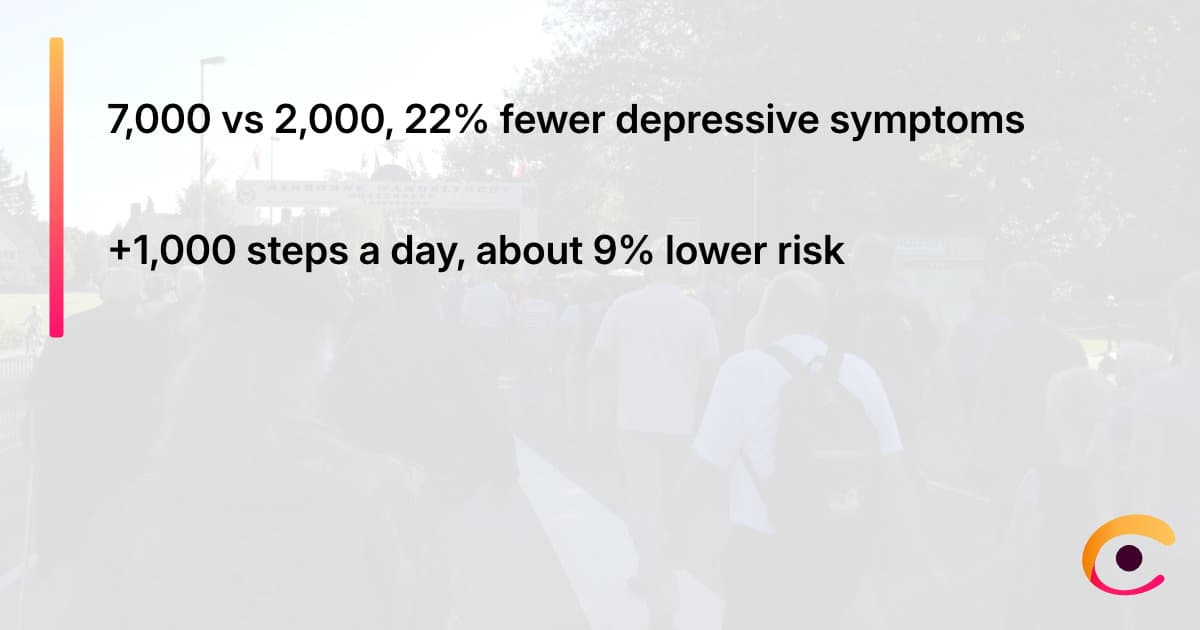
The 2024 review. A team at the University of Castilla-La Mancha pooled 33 studies covering 96,173 adults, all with steps counted by a device rather than remembered. People who walked more reported fewer depressive symptoms. Compared with under 5,000 steps a day, every higher band (5,000 to 7,499, 7,500 to 9,999, and 10,000 plus) was linked with fewer symptoms. In the studies that followed people over time, those at 7,000 steps or more had about a 31% lower risk of depression than those below it, and each extra 1,000 steps a day was linked with about a 9% lower risk.
The 2025 review. A team led by the University of Sydney looked at 57 studies of device-measured steps and a long list of health outcomes. Against 2,000 steps a day, 7,000 was linked with a 22% lower risk of depressive symptoms. Even 4,000 steps went with better health than 2,000.
Day by day. Smaller studies that check in with people several times a day find something closer to home. In one, on days with more steps, everyday stress from the people around them weighed less on participants' mood.
One honest caveat before going further: these are observational studies. They show that steps and mood move together, not that one causes the other.
Why a walk might help
Nobody has one tidy answer, and it's probably not just the steps. A walk tends to bundle several things together:
- Daylight. Most steps happen outside, and even a gray morning is far brighter than indoor light. We wrote more about that in our piece on the winter blues.
- A change of scene. Ten minutes away from a desk or a screen is a break your head notices, not just your legs.
- Company. Plenty of steps come with people attached: the dog, a friend, the walk to the school gate.
- A day with some shape. High-step days are often days you went somewhere and did something. Low-step days are often the ones that never really got going.
That last one is why your own data matters. A high step count might be doing the work, or it might just be a sign of a fuller day. Seeing which, for you, takes a few weeks of both.
About that 10,000
Ten thousand steps was never a research finding. In 1965, riding the fitness buzz around the Tokyo Olympics, a Japanese company launched a pedometer called the Manpo-kei, which translates to "10,000-step meter." The round number came from the product name, and it stuck.
More steps aren't bad. But the research above suggests the mood link builds gradually, with no finish line at 10,000. The 2025 review's own authors call 7,000 a more realistic aim for most people.
There's a gentler point too. A goal you miss most days can turn a step counter into one more thing you're failing at. For mood, the more useful question isn't "did I hit the number?" It's "what's my normal, and how do I feel on the days above it?"
It runs both ways
Mood moves steps as much as steps move mood. In one family study, people moved more on days they felt better and more energetic than usual. When you're low, the walk is often the first thing to go.
So if a rough week shows up as a quiet week on your step count, that's not a verdict on you. It's information. Sometimes a short walk helps lift a heavy day. Sometimes the heavy day is why you didn't walk. Both are worth knowing, and neither needs fixing in a hurry. If stress is part of the picture, our guide to managing stress in everyday life has a few more ideas.
Seeing your own pattern in Luci
The studies describe the average of a lot of people. You're one person, and your pattern might look nothing like theirs. That's what the new Steps & mood card in Luci is for.
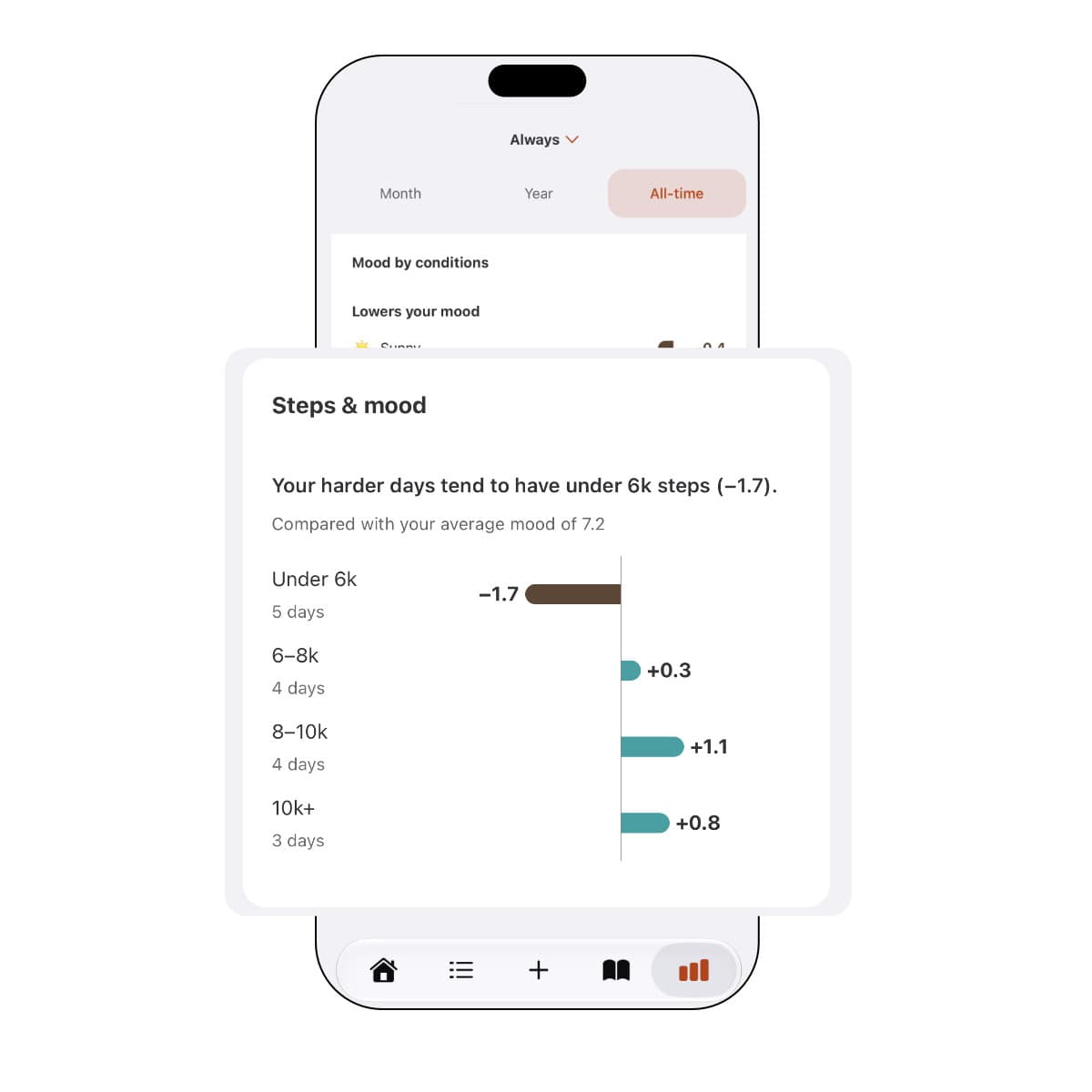
On iPhone, if you choose to bring in your step count from Apple Health, it now has its own card in your stats. Luci groups your days by how many steps you took and shows how your mood on each kind of day compares with your average. At the top, it sums up the clearest result in one plain sentence, such as "Your better days tend to have 8–10k steps." The ranges start broad and split finer as your days build up, and a range with only a few days behind it is marked as less certain.
A few things stay the same:
- It's opt-in. Steps have their own switch in Luci, and it starts off. You can withdraw access at any time in Apple Health.
- It's yours. Your step counts are stored on your device with your entries. If you turn on sync, they travel with those entries in encrypted form. Luci never sells them, shares them or uses them for ads. Read more in our privacy policy.
- It's a pattern, not a prescription. The card shows what turns up together. What it means is up to you.
The card is free on the month view. The year and all-time views come with Luci Pro. The health connection is not currently available on Android.
Give it a few weeks before reading much into it. A month tells you about a month. A season starts to tell you about you.
Small ways to try it this week
No plan, no streak to protect. Just a few easy experiments, and then look at what the card shows.
- Find your normal first. Check your average over the last couple of weeks before changing anything.
- Add about 1,000. That's roughly ten minutes of walking, the step the 2024 review linked with a lower risk.
- Take the long way once a day. One stop early, the far entrance, the stairs.
- Walk with someone. A call, a friend, the dog. It counts twice.
- Tag what was around the walk. The weather, the company, the time of day. That's often where the real pattern is hiding.
If your mood has been low for a while and walking isn't touching it, that's worth talking to a doctor about. You don't need to be sure it's "bad enough" first.
Luci is not a medical device, and this article is not medical advice.
Find out what really lifts your mood.
Sources (5)
- Daily Step Count and Depression in Adults: A Systematic Review and Meta-Analysis
- Daily steps and health outcomes in adults: a systematic review and dose-response meta-analysis
- Daily steps buffer the impact of daily stress on mood
- Affective states as predictors of physical activity (SMARTFAMILY trial)
- Is the 10,000 steps goal a fitness fact or merely a marketing myth?

Luci
Bringing light to your mental health journey.