Insights & statistics
What actually affects your mood
You can feel that some weeks are heavier than others. What's harder is saying why, or whether anything you changed has helped.


Memory is a poor witness here. By the time a pattern is obvious enough to notice, the details that caused it have gone, and we reliably misremember which weeks were bad. Recall keeps the peaks and the troughs and quietly discards everything in between. Counting beats remembering, which is the entire reason to write anything down. Luci does the counting on the entries you've already made, and answers two different questions with them: what moves your mood, and where it's heading.
It starts with what you tag
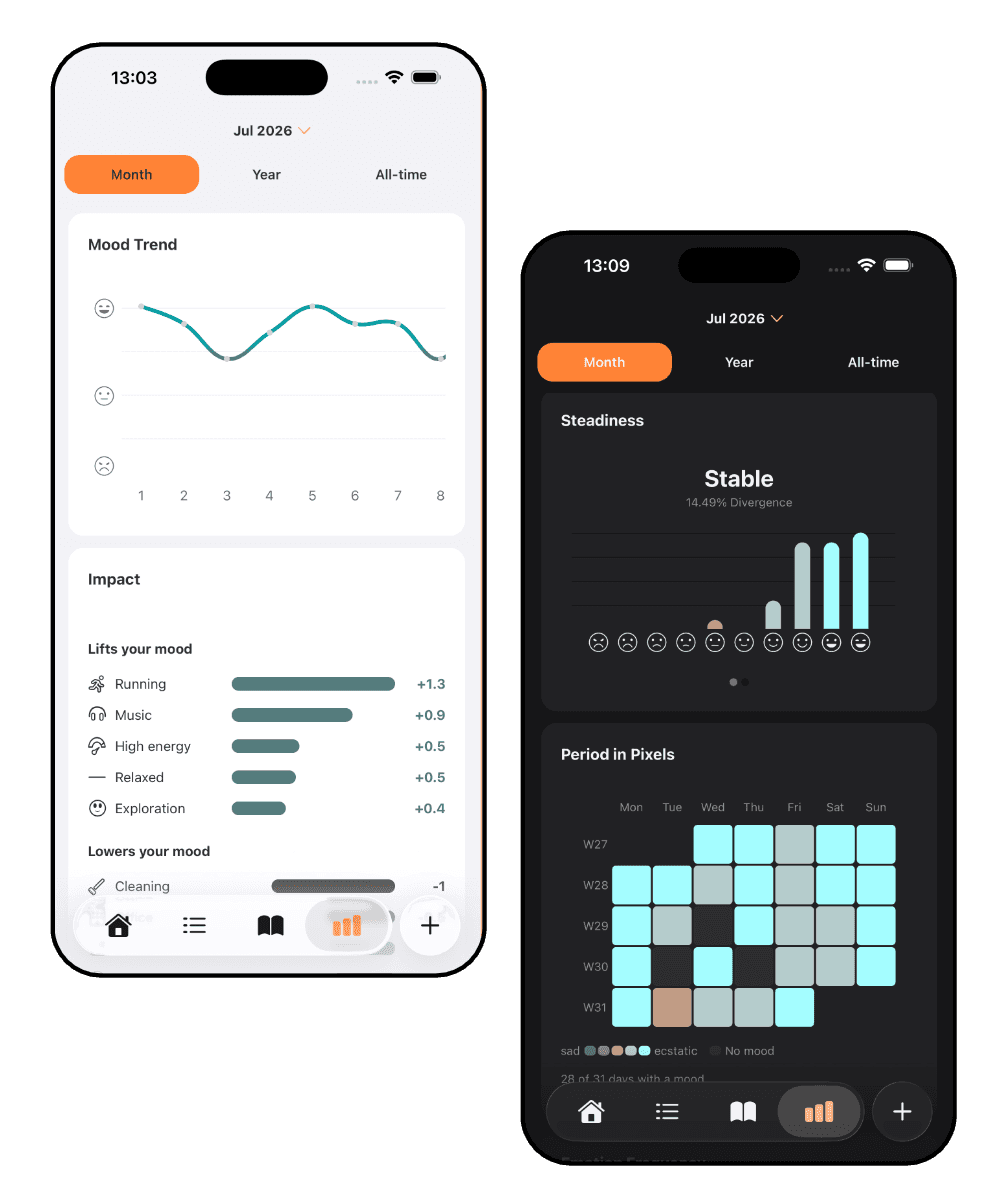
Every entry can carry the things around it: who you were with, where you were, what you'd done, how you slept. On its own, one tagged entry says very little. You already knew Tuesday was hard. Two hundred of them say quite a lot, because the same tag appearing beside your better days forty times is not something you can talk yourself out of. This is the part that takes patience: the tags are an investment that pays nothing for the first few weeks and then starts paying steadily.
Answers in words, not charts to decode
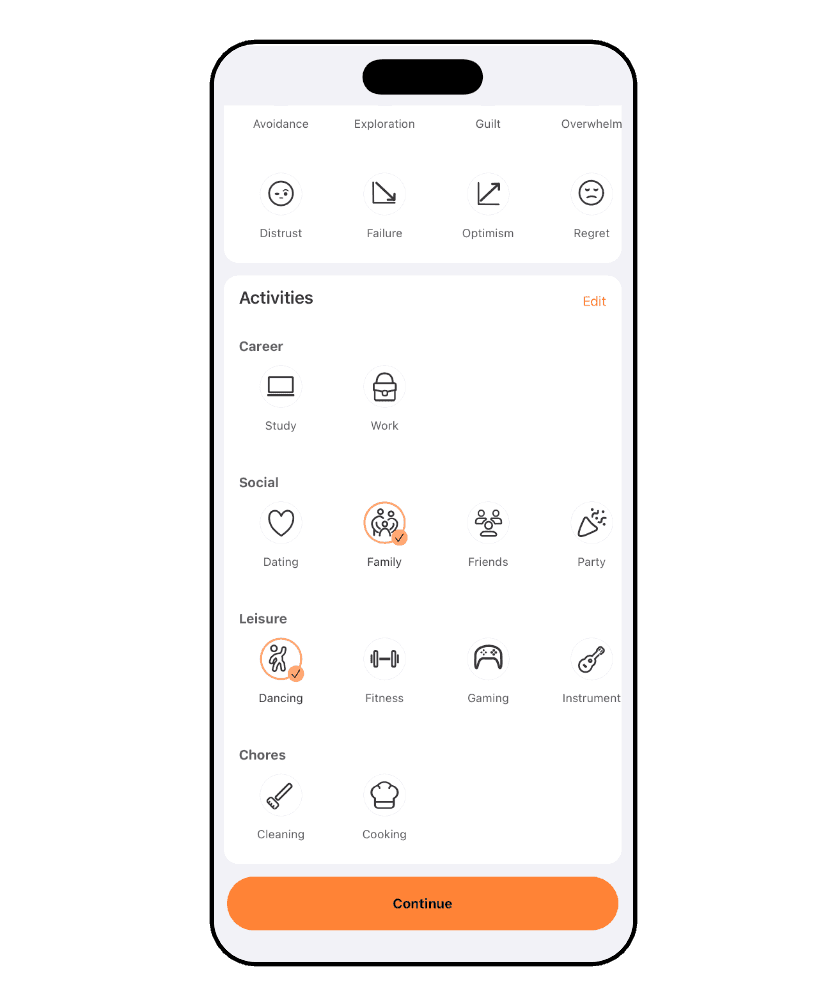
Luci looks across everything you've recorded and surfaces what it finds as a sentence: that your mood is lower the day after short sleep, or that a particular person shows up again and again on your best days. Each observation names the stretch of time it's drawn from, so you can judge for yourself whether you believe it: five weeks of evidence deserves more weight than five days. The underlying chart is still one tap away when you want to check the working. You just don't have to read one to get the point, which matters on the days when you have least patience for being handed a graph.
Your average, over whatever period you like
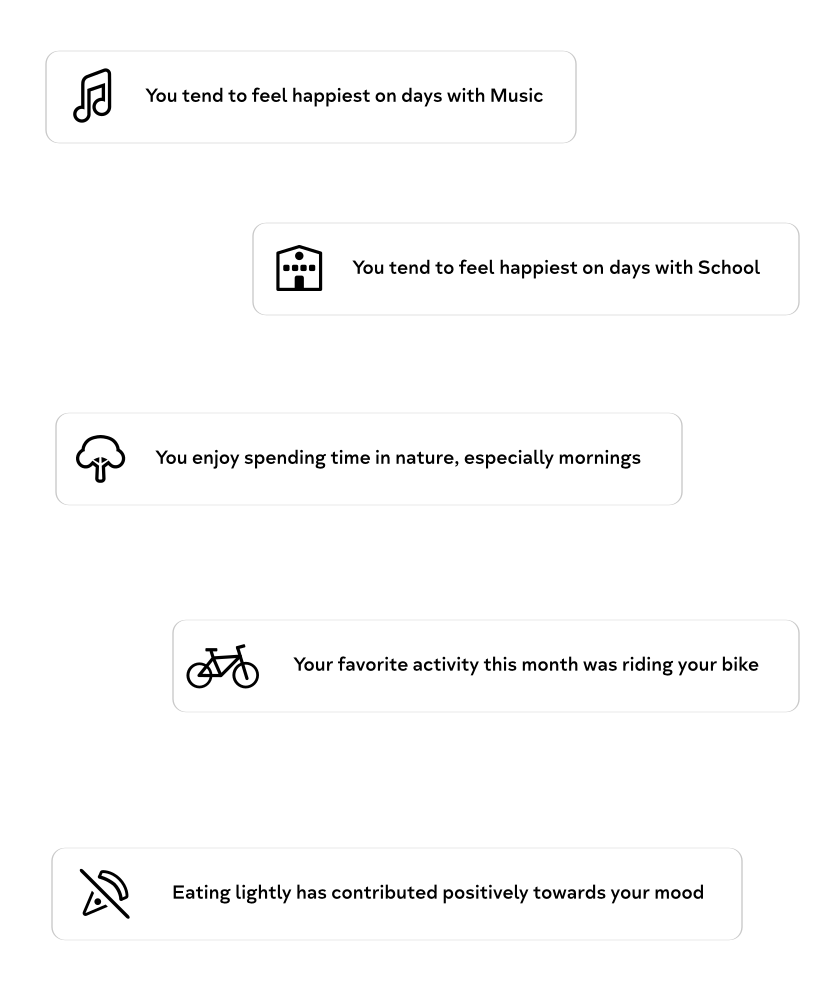
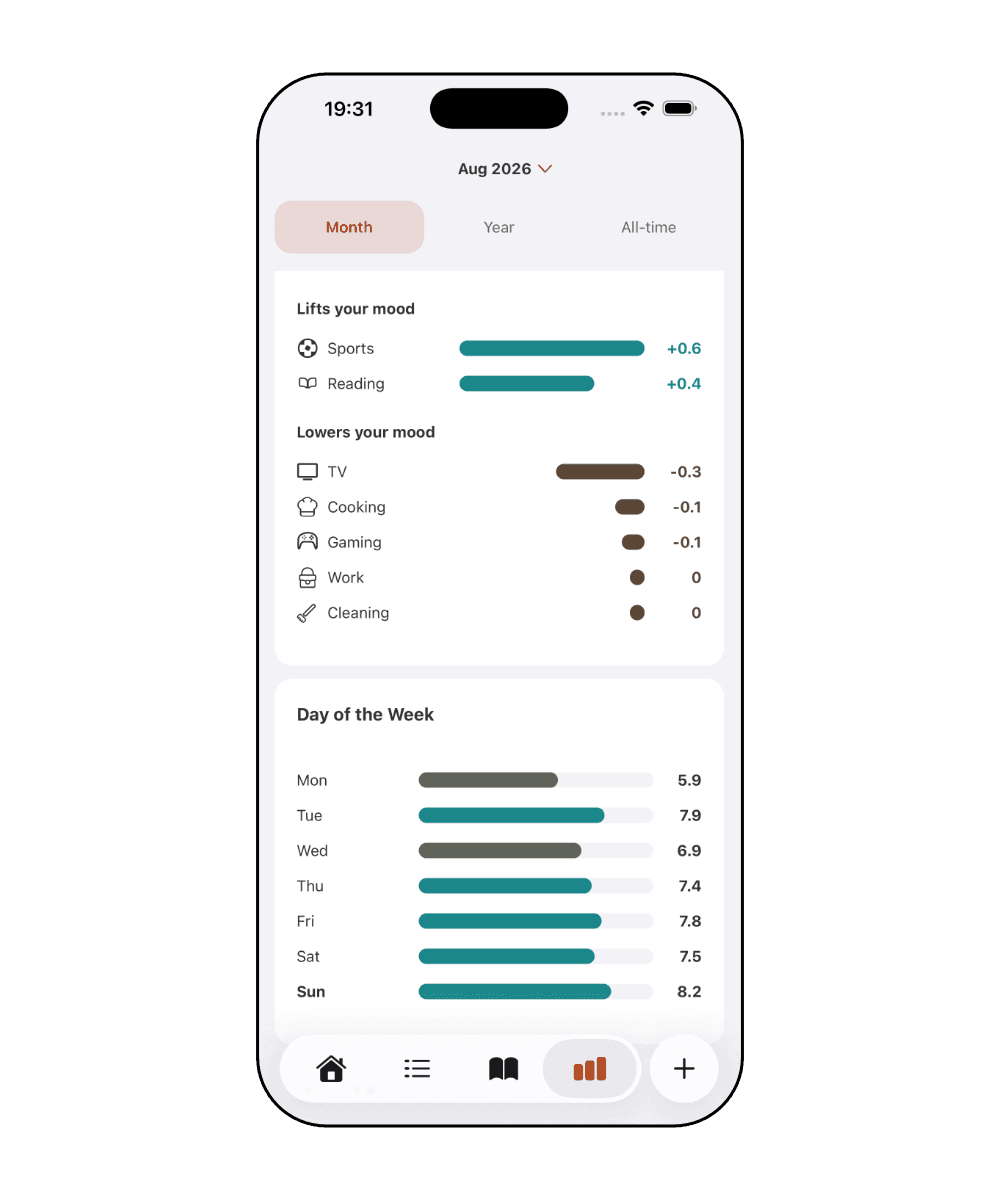
A month, a season, a year, or everything you've ever logged. Compare this month against last, or this winter against the one before. The useful number in mood tracking isn't today's score, it's the trend underneath it. Slow drifts are invisible from the inside. A decline of a point across two years is not something anyone notices day to day, and is very hard to miss on a graph. This is also the only honest way to answer whether a change you made actually worked: the new job, the earlier bedtime, the thing you stopped doing.
Which influences carry real weight
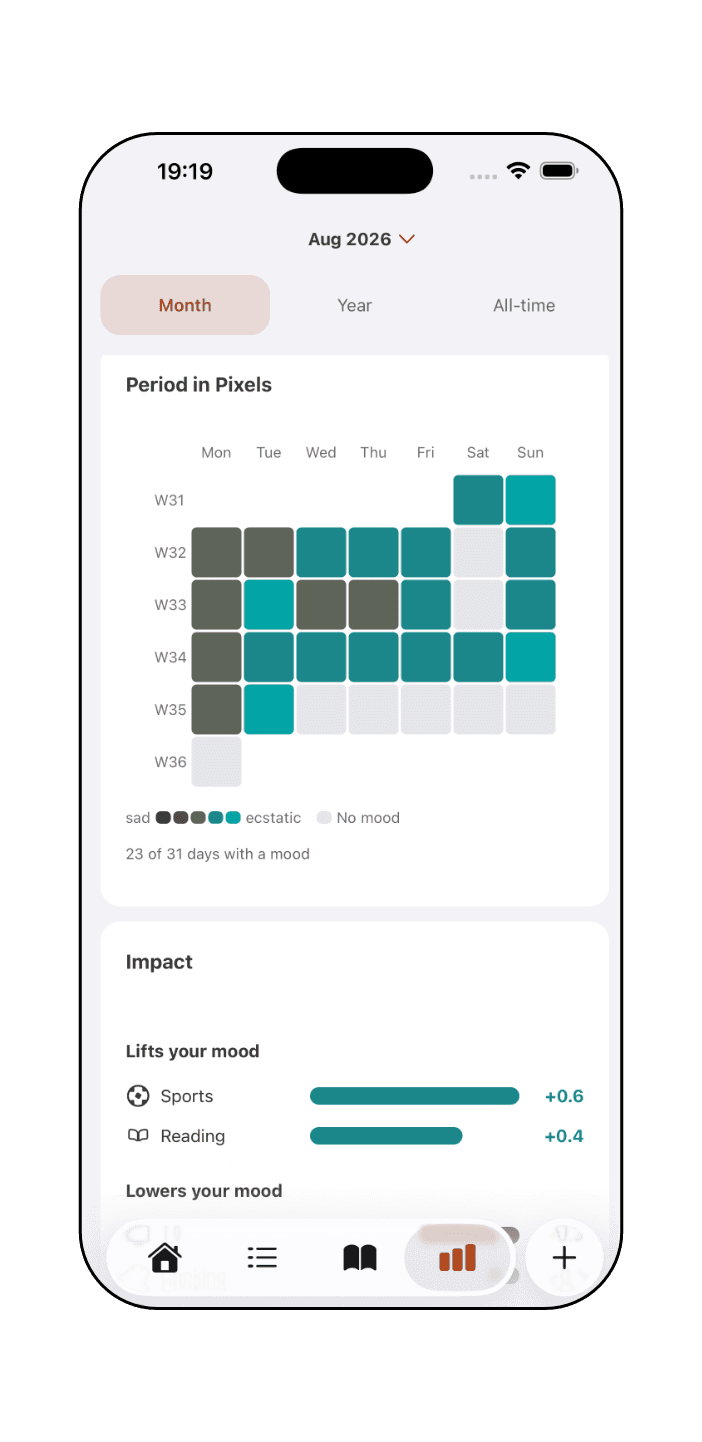
Luci ranks the things you tag by how far they shift your average, with direction and size shown: baking might be +0.2, a particular recurring meeting −1.2. It's a blunt instrument, deliberately. The point isn't the precise figure, it's seeing which two or three things carry genuine weight and which ones you'd assumed mattered and simply don't. People are frequently surprised by the small things near the top of the list, and by how far down the list the thing they'd been worrying about actually sits.
Who this is for
For the point where you have entries and want them to be worth something.
You've been logging and want a payoff
A few months in, the entries stop feeling like they're going anywhere. This is the part that makes them worth having: the same tags counted across hundreds of days, turned into a handful of sentences about what has actually been moving your mood.
You changed something and want to know if it worked
A new job, an earlier bedtime, less of a particular person. Whether it helped is close to impossible to judge from the inside, because you have nothing to compare against but a memory of how you used to feel. Comparing this quarter's average with last quarter's is a much fairer test.
You want to argue with your own assumptions
Most of us carry a story about what makes us feel better: exercise, an early start, seeing people. Sometimes the ranking agrees. Fairly often something small and unglamorous sits above all of it, and the thing you'd been organising your week around turns out to be somewhere in the middle.
Common questions
How long before Luci finds anything?
Roughly a few weeks of regular logging. Weekly rhythms surface first, seasonal ones need most of a year. Luci says how much data each observation rests on, so you can weigh a new one appropriately.
Is this done with AI?
No. It's statistics, and it runs on your device. Finding correlations across a few thousand entries is a maths problem a phone handles comfortably. Your journal is never sent anywhere to be analysed, not to us, not to anyone.
Does a pattern mean one thing caused the other?
No, and Luci doesn't claim it does. A correlation is a prompt to think, not a diagnosis. Poor sleep and low mood travel together in both directions, and something you haven't tagged at all may be driving both. Treat what surfaces as a question worth asking.
Will logging a bad day drag my average down?
It will, and that's what an average is for. Try not to manage the number. A tracker you're curating tells you about your curation rather than your mood.
Can I get my data out?
Yes. Export the whole journal as a PDF or a backup file whenever you like. There's no lock-in.
Start where you are
Luci is free, works offline, and asks for about ten seconds a day. No account needed.