Mood logging
Ten seconds is enough
The best mood tracker is the one you're still using in March. Luci is built to be quick enough that you keep going.


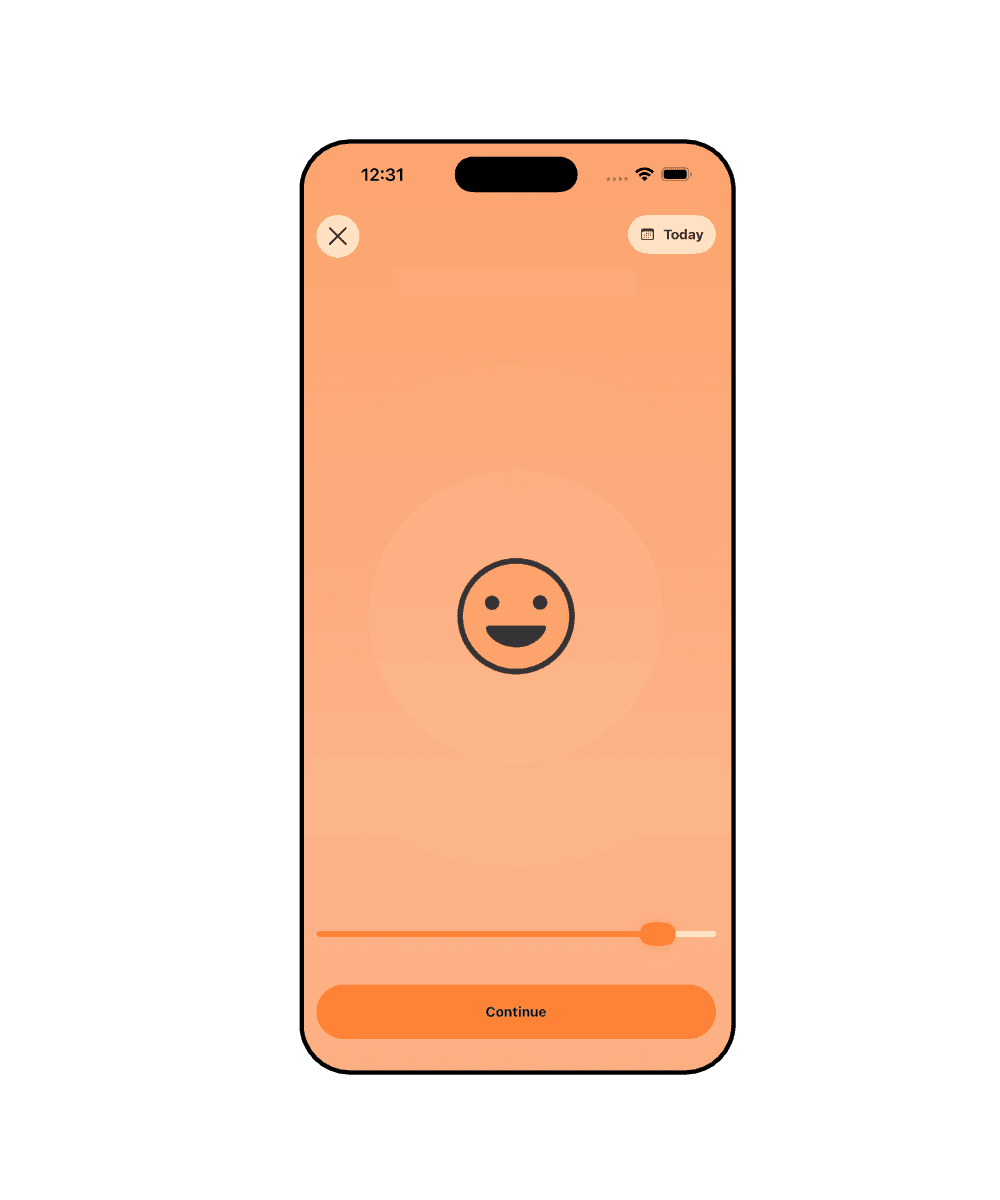
Most mood-tracking habits die for the same reason: logging is a chore. A form with nine fields is a form you'll skip on a bad day, and bad days are exactly the ones worth recording. So Luci asks one thing of you: how you feel, right now. Everything else is optional. One drag on a slider is a complete, valid entry. Everything below is what you can add when you have the energy, not what you must add to be allowed to save.
Choose a scale that means something to you
Numbers, smileys, or a plain 1–10. There's no correct answer, and which one you pick matters far less than picking one and staying with it. A score is only meaningful next to your own other scores. If numbers feel clinical, use faces. If faces feel vague, use numbers. It helps enormously to write down what a few points on your scale actually mean to you: a 3 might be "only want to be in bed", a 7 "present, and ready for the day". Anchoring the scale like this is borrowed from physical therapy, and it's what stops a 6 in January meaning something different from a 6 in June. You can change scale later without losing any history.

Tag what was going on, when you feel like it
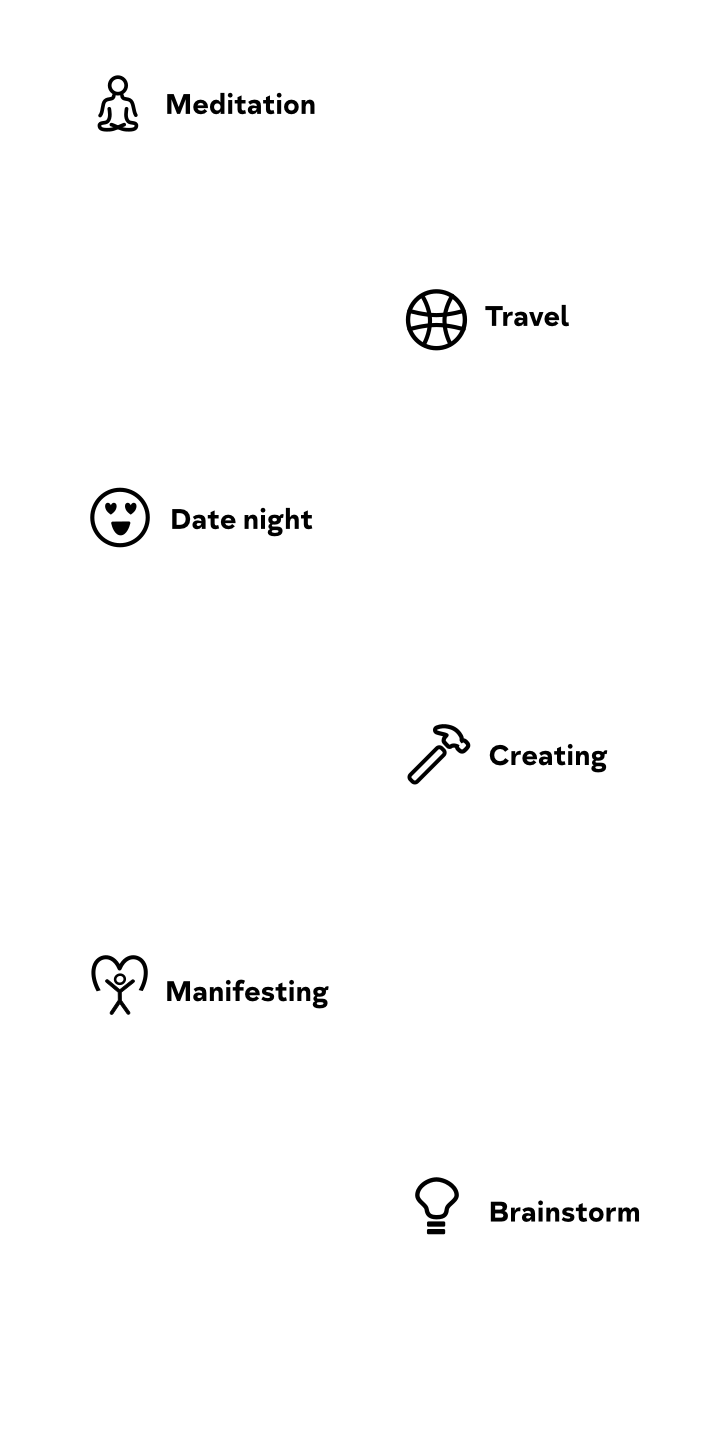
Activities, people, places, sleep, energy, appetite, and your own thoughts. Add your own categories when the built-in ones don't fit. You're not limited to a list someone else wrote, and the things that actually move your mood are often too specific for a stock list. A few weeks after a car accident, "driving" might be the single most useful thing you could be tracking. These tags are what later turn a wall of scores into an actual answer about what affects you. But nothing breaks if you skip them on a rushed day, and a bare score is still worth having.
From your wrist, without reaching for your phone
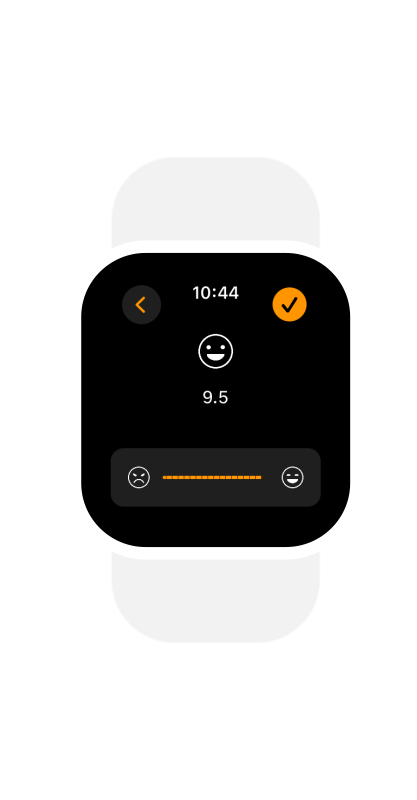
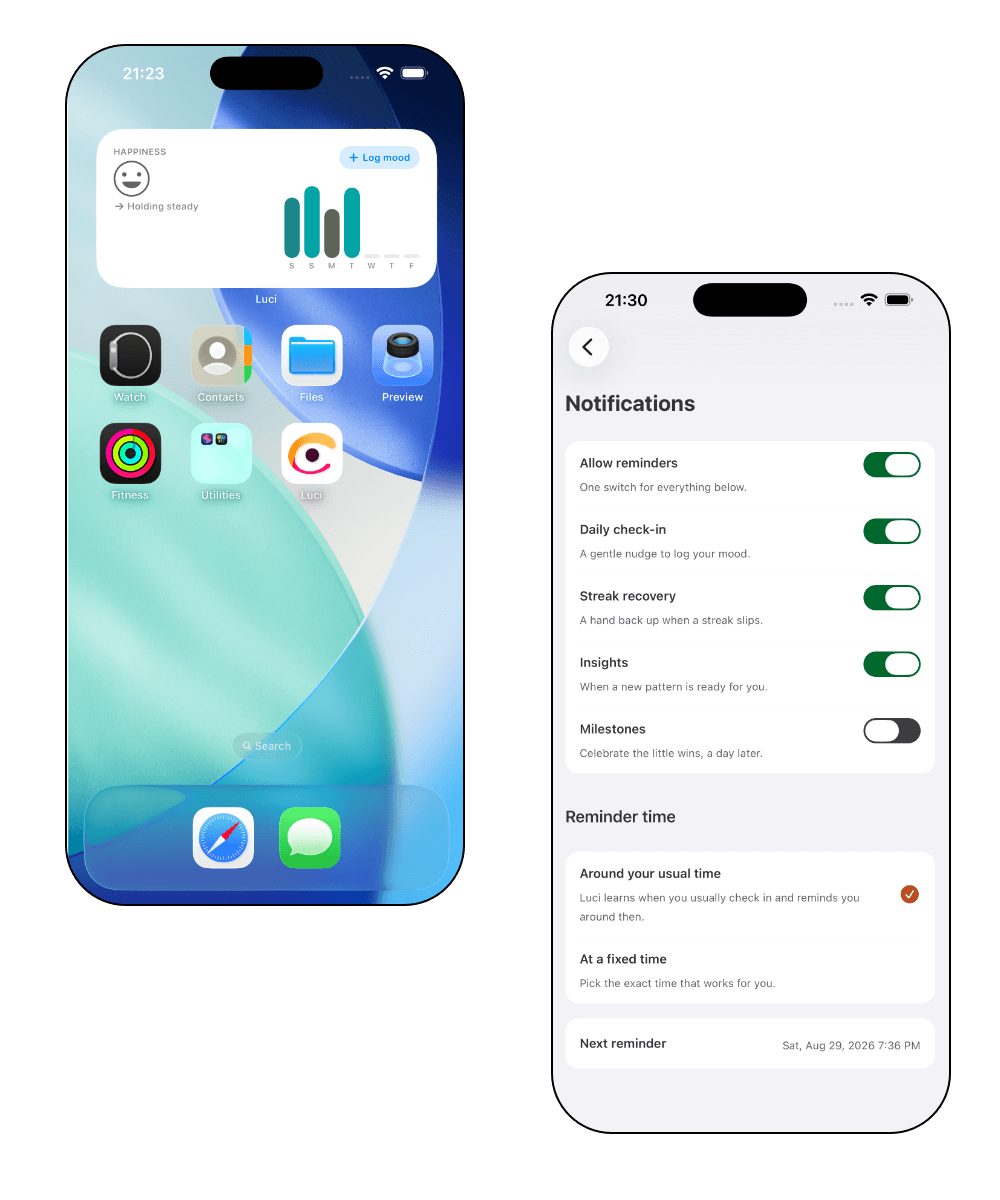
Luci runs on iPhone, iPad, Android and Apple Watch, with the same layout, the same tracked items and the same icons on each. Logging from the watch is often the difference between catching a feeling as it happens and reconstructing it wrong three hours later. Reconstruction is where mood data quietly goes bad, because we remember how a day ended rather than how it went. There's a home screen widget too, for the same reason: the fewer taps between noticing something and recording it, the more honest the record.
The habit matters more than the accuracy
A roughly-right entry every day beats a perfect entry twice a week, because patterns live in the regularity rather than in the precision of any one score. Set a reminder for a time you're reliably free (most people choose just before bed) and let it come to you rather than relying on remembering. If you miss a stretch, leave the gap rather than backfilling from memory. Missed days cluster around busy and difficult periods, which makes the gaps themselves worth seeing.
Who this is for
Mostly for people who have tried this before and stopped.
You've quit a tracking app before
Usually the app wasn't the problem. The friction was. If your last one asked for a paragraph, a category and three sliders before it would save anything, you stopped for a sensible reason. Try one where the minimum viable entry is a single drag, and add detail only on the days you feel like it.
You suspect something is affecting you
A job, a person, a room, a sleep pattern. You can feel it but you can't prove it, and arguing with yourself about whether it's real is exhausting. Tagging entries for a couple of months settles it one way or the other, and either answer is a relief compared to wondering.
You're between appointments
"How have the last six weeks been?" is a hard question to answer well from memory in a room with a clock running. A record you can scroll turns that into something concrete you can bring with you, and you can export it as a PDF to take along.
Common questions
How often should I log my mood?
Once a day is plenty to see patterns within a couple of months. Log more often if a day swings. Luci averages multiple entries into a single score for that day, so extra entries add detail rather than noise.
What if I miss a few days?
Nothing breaks and nothing is lost. Fill them in if you genuinely remember, leave them blank if you don't. A guessed entry is worse than no entry, because it looks identical to a real one later.
Do I need an account?
No. Luci works offline with no sign-up and no email address, and your entries stay on your device unless you turn sync on yourself.
Can I change my mood scale later?
Yes, and your history comes with you. It's worth settling on one fairly early though. Comparing a year of smileys against a year of numbers is harder than it sounds.
Won't logging a bad mood make me feel worse?
Usually the opposite. Naming a feeling and putting it somewhere tends to take some of the charge out of it, which is a well-documented effect and part of why journalling helps at all. If a day is too heavy to write about, a bare score is a complete entry.
Start where you are
Luci is free, works offline, and asks for about ten seconds a day. No account needed.