
In many ways it's a wonder humankind made it through the Stone Age at all, let alone to where we are now. We had to find food, shelter and warmth, and every now and then fight off a threat from animals looking for the same. How does one survive a fist fight with a tiger? Sure, we had our wits and our fine motor skills to help, but it's still quite the achievement.
Well, it turns out our body has a special setting just for these occasions. Stress peaks and a system called "fight or flight" kicks in. Suddenly we are sharp and laser focused, as if all of our brain and body is working on this one threat.
Fast forward to today, and this exact system might be the one fighting us instead. Let's dig a bit deeper into managing stress in everyday life.
Stress is like a sprint
In many ways we are a fortunate generation, far removed from the days in the intro. Instead we face threats such as a missed deadline, a train that won't leave the station, or holding an umbrella while steering a bike in the rain. Most everyday situations are a far cry from a fight with a tiger, yet we still feel stress. Our breath gets short, our stomach tingles and our head feels heavy, because we know the thing has to get done.
In these moments the body sends out a quick burst of adrenaline, followed by cortisol if the pressure keeps up. Together they give us focus and energy right when we need it most. This is a good thing. We get our goal done and move on with our lives.
But as the world moves faster, that burst tends to come more often. Every email, every task at work, the school run: all these mundane everyday moments can now start the internal rat race. Stress works like a sprint. It is incredibly useful for getting a job done, and it was never meant to run all day.

Life is like a marathon
Our everyday life is not a 400 metre race. It's a marathon. We are expected to show up every day, do our due diligence and perform well enough not to step on any toes. Rinse and repeat. In between we enjoy moments of happiness, hopefully, but the call of the mountain, so to speak, is forever there.
Here are a few stress triggers that have grown a lot in the last twenty years:
- Work no longer stays behind at the office when the day ends. We work remotely and always have access to our work environment
- News arrives instantly, from many different sources. Not just once a day in the newspaper
- Social media shows us other people's lives around the clock, and often a filtered version of reality
- Bills come in digitally, whenever and wherever you are. Even on your phone while you are on vacation
- Students can get exam results at any time, straight on their phone, even at the weekend. Right in the middle of movie night with their parents
Twenty years ago, most stress triggers still had a time and a place, and we had ways to hide from them for a while. To recharge the battery, let's say. How often we let them in matters too. In one study, people who checked their email only three times a day felt less daily stress than in a week when they checked it as often as they liked.
So when life is a marathon, how can we outrun stress? We can't, really. Let's go over a few ways to at least hide in the bushes every now and again.
Why daily stress wears you down
It starts with knowing that constant stress should not be considered normal. Psychologists often describe the link between pressure and performance as an inverted U, known as the Yerkes-Dodson law. A little pressure sharpens you. Past a certain point, more pressure makes you worse at the very task you are stressing about.
Your body pays a price too. A short burst of stress briefly revs up parts of the immune system. Stress that goes on for weeks or months does the opposite: a review of thirty years of research found chronic stress was linked to lower immune function across the board. Keeping the stress response switched on also takes a toll on your heart, your sleep and your mood.
And there's a catch. Every burst of stress seems to pay off, because it works. We make the deadline and tell ourselves: "See, I made it." We reward the stress, and next time it shows up a little sooner. Soon every everyday situation becomes a sprint to the finish line. That's not how you run a marathon.
Yes, you deserve stress, but only sometimes
Some stress is part of a full life. You do deserve it, sometimes. But you deserve sunshine, good company, positivity, gratitude and creativity way more. So how do we get there?
1. Track when stress shows up
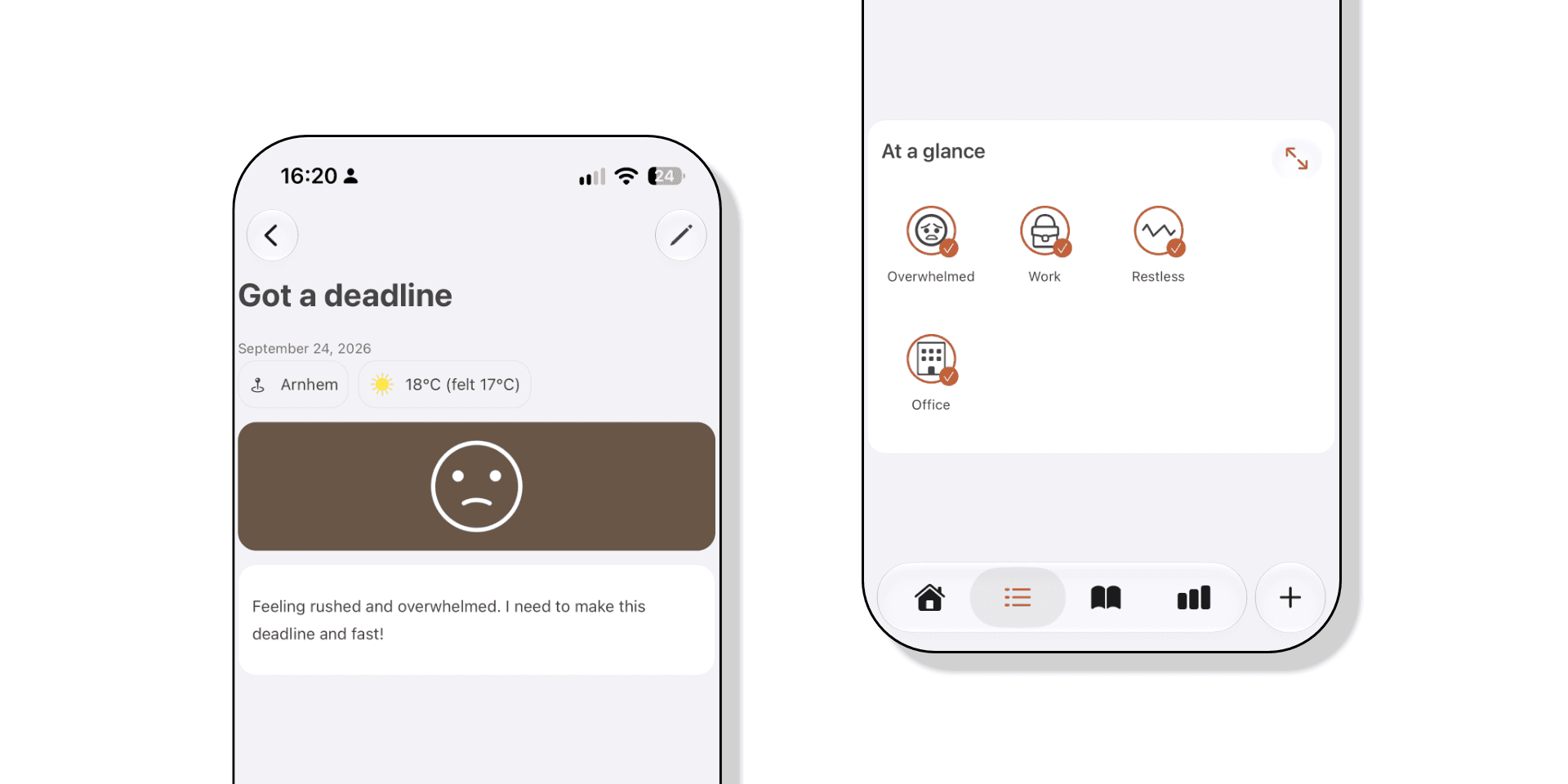
Start by noting whenever you feel stressed, and note the trigger too. Write it in a journal or a mood tracker: "Feeling stressed, got a deadline." Or: "Feeling stressed, missed a digital bill and now there's a late fee." Simply putting a feeling into words can take some of the edge off it. Researchers call this affect labelling. After a few weeks, you will see which triggers keep coming back.
Don't be fooled into thinking that being stressed now means you can relax later. That's a mind trap.
2. Breathe in boxes
Now that you have a way to see how often stress shows up, let's work on recovering from it. There are many ways to ease the feeling of stress, such as meditation or box breathing. Box breathing was popularised by the US Navy SEALs and is especially easy because you can do it anywhere, in a meeting or on a train that won't move.
Here's how it works. Split each breath into four counts of four:
- Breathe in for 4 seconds
- Hold for 4 seconds
- Breathe out for 4 seconds
- Hold for 4 seconds
Repeat this ten times whenever stress hits your body. In a Stanford study, people who did five minutes of breathwork a day for a month felt more positive and breathed more slowly at rest. Box breathing was one of the techniques they tested.
3. Find your marathon pace
Tools like these are great in the moment. In the long run, a change of mindset is what carries you. Stop seeing your life as a fight with several tigers. See it as a marathon. We can sprint every now and again and beat the clock. Then we return to our holding pace. Zone 2, if you are a runner. You don't have to remember that term. Just know that in zone 2 you can comfortably talk while you keep going.
The World Health Organization's own advice points the same way: keep a daily routine, protect your sleep, move every day, stay in touch with people you trust and limit how much news you take in. None of it is dramatic. That's the point. It's the pace you can hold.

And that is exactly what a life run as a marathon looks like. Light, and joyful most of the time. You deserve just that.
If you want to dig into what sits behind your stress, our journal prompts for stress are a good place to start. So is our post on how to live less anxious.
If stress stays with you for weeks, or starts to affect your sleep, work or relationships, talk to your doctor or a mental health professional.
Sources (7)
- Stress
- Understanding the stress response
- Psychological Stress and the Human Immune System: A Meta-Analytic Study of 30 Years of Inquiry
- Arousal and performance: revisiting the famous inverted-U-shaped curve
- Checking email less frequently reduces stress
- Putting Feelings Into Words: Affect Labeling Disrupts Amygdala Activity in Response to Affective Stimuli
- Brief structured respiration practices enhance mood and reduce physiological arousal

Luci
Bringing light to your mental health journey.