
What are cognitive distortions?
Cognitive distortions are habits of thinking that bend how we see a situation, usually in a more negative direction than the facts support. Everyone has them. They tend to run on autopilot, so they feel like the truth rather than an interpretation. Cognitive behavioral therapy calls them by this name and teaches people to notice and question them.
Example: Your friend doesn't reply to a message all day. Within an hour you have decided they are annoyed with you (mind reading), that you always push people away (overgeneralization), and that the friendship is probably over (catastrophizing). Three traps, one unanswered text.
Your mind is constantly telling you a story about what is happening. Most of the time that story is close enough to the facts. But when you are tired, stressed or low, the story starts to bend. One awkward moment becomes a ruined evening. One missed deadline becomes proof you are bad at your job. These bends follow surprisingly predictable patterns, and psychologists call them cognitive distortions. We call them mind traps.
The good news is that a pattern you can name is a pattern you can catch. This page lists the twelve most common cognitive distortions, each with a plain meaning and an everyday example. Where we have written a full guide on one, you will find a link to it.
Where the idea comes from
The term comes from psychiatrist Aaron Beck. In 1963, while studying the thoughts of people with depression, he noticed the same errors in reasoning coming up again and again: picking out one negative detail, drawing broad conclusions from a single event, blowing problems out of proportion. He called them cognitive distortions. That work grew into cognitive behavioral therapy, or CBT.
Psychiatrist David Burns later made the idea widely known with a list of ten distortions in his 1980 book Feeling Good. Lists today vary a little in length and naming. The twelve below are the ones you will meet most often.
Cognitive distortions are not a diagnosis, and having them does not mean something is wrong with you. They are ordinary habits of a human mind. They only become a problem when they run the show unnoticed.
12 common cognitive distortions
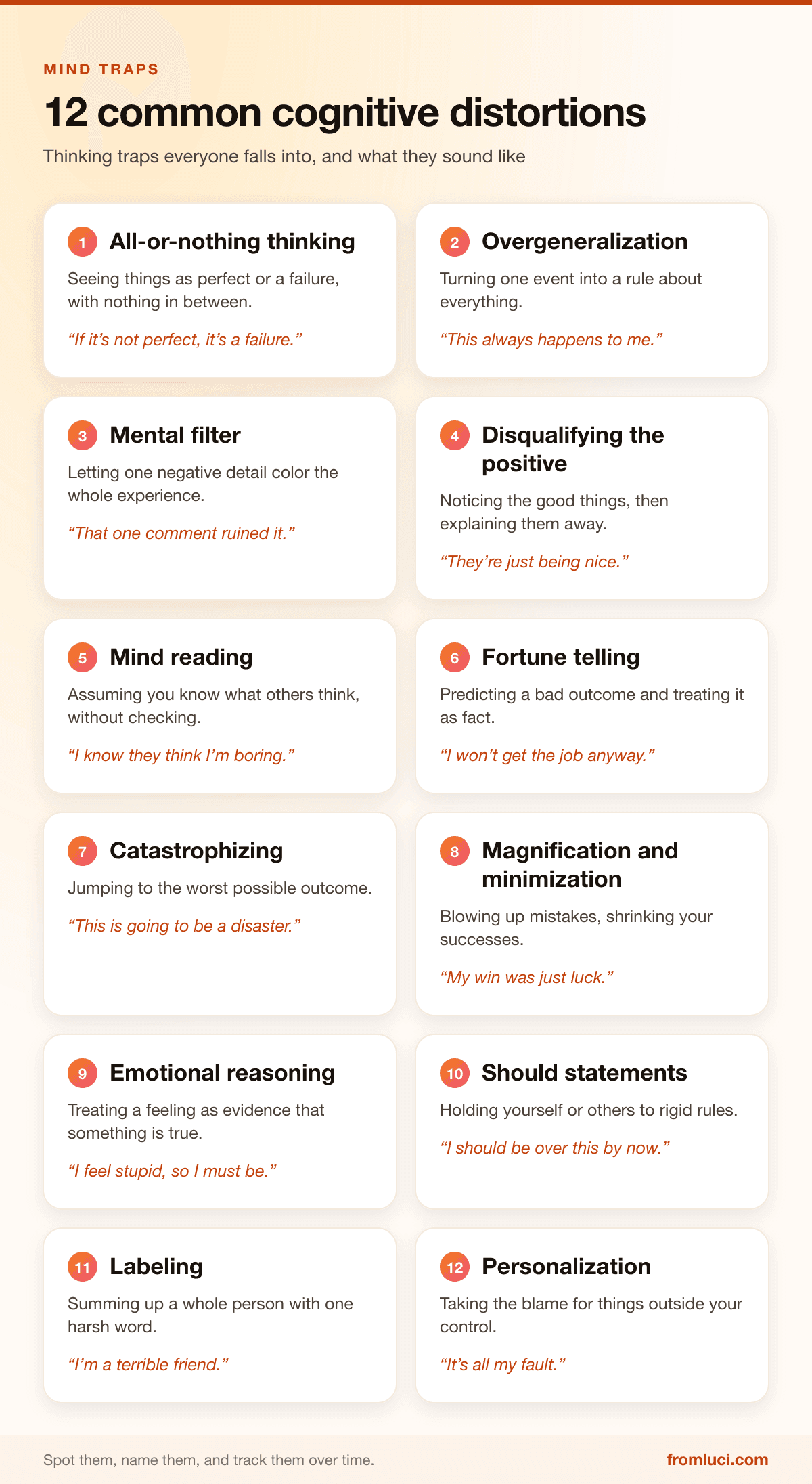
1. All-or-nothing thinking
Also called dichotomous or black-and-white thinking. You see things in two categories only: perfect or a failure, good or bad, always or never. There is no room for the middle, which is where most of life happens.
Example: you skip one workout and decide the whole fitness plan has failed.
Read more: dichotomous thinking.
2. Overgeneralization
You take one event and turn it into a rule. Words like "always", "never" and "everyone" are the giveaway.
Example: one date goes badly and you conclude that you will always be alone.
Read more: overgeneralization.
3. Mental filter
Also called selective abstraction. You pick out one negative detail and dwell on it until it colors the whole experience. Everything that went well fades into the background.
Example: forty kind comments on a post and one snarky one. The snarky one is the one you remember.
Read more: selective abstraction.
4. Disqualifying the positive
A close cousin of the mental filter. Instead of ignoring the good things, you notice them and then explain them away. They "don't count".
Example: a colleague praises your work and you think, "They're just being nice."
5. Mind reading
You assume you know what other people are thinking, usually something negative about you, without checking.
Example: your manager looks serious in a meeting and you are sure they are unhappy with you.
Read more: mind reading.
6. Fortune telling
You predict that things will turn out badly and treat the prediction as a fact. Together with mind reading, this is sometimes called jumping to conclusions.
Example: "There's no point applying. I won't get the job anyway."
7. Catastrophizing
You jump to the worst possible outcome and treat it as likely. One worry leads to the next, and each step feels more certain than the last.
Example: a headache becomes a serious illness, then time off work, then losing your job, all before lunch.
8. Magnification and minimization
You blow your mistakes and other people's strengths out of proportion, and shrink your own strengths and successes until they look like nothing.
Example: a small typo in an email feels huge, while finishing a big project on time barely registers.
Read more: magnification and minimization.
9. Emotional reasoning
You treat a feeling as evidence. If you feel it, it must be true.
Example: "I feel stupid, so I must be stupid." Or "I feel anxious about this flight, so something must be wrong."
Read more: emotional reasoning.
10. Should statements
You hold yourself, or others, to rigid rules about how things should be. When the rules are broken, the result is guilt when it is you and frustration when it is someone else.
Example: "I should be over this by now." "They should know how I feel."
11. Labeling
You sum up a whole person, often yourself, with one harsh label based on one thing they did.
Example: you forget a friend's birthday and think, "I'm a terrible friend," instead of "I forgot a birthday."
12. Personalization
You take responsibility for things that are not fully, or at all, in your control. The opposite habit, blaming others for everything, is often listed alongside it.
Example: your child struggles at school and you decide it is entirely your fault as a parent.
Other mind traps we write about
Some thinking traps do not appear on the classic list but work in a similar way. They take a grain of truth and stretch it until it distorts the picture.
- The gratitude trap. Feeling that you are not allowed to feel bad because others have it worse.
- Imposter syndrome. The nagging fear of being exposed as a fraud, even when your success is real. It often combines disqualifying the positive with fortune telling.
- The sunk cost fallacy. Sticking with something because of what you have already put in, rather than what it will give you from here. Strictly speaking it is a cognitive bias about decisions rather than a distortion about yourself, but it traps people just as well.
How to spot your own thinking traps
Reading a list is the easy part. Catching a distortion in the moment is harder, because from the inside it does not feel like a distortion. It feels like the truth. A simple exercise from CBT, often called a thought record, helps you slow down enough to see it.
Next time you notice a sudden drop in mood, take two minutes and write down:
- What happened. Just the facts, as a camera would see them. "My friend didn't reply to my message today."
- How you feel. Name the emotion and how strong it is. "Anxious, 7 out of 10."
- The thought. What went through your mind? "She's annoyed with me. I always mess up friendships."
- The trap. Check the list above. Does the thought match one or more? Here it is mind reading and overgeneralization.
- A more balanced thought. Not a forced positive, just a fairer one. "She might just be busy. One unanswered message doesn't say much about our friendship."
Then notice how you feel. Often the emotion softens a little, and that is enough. You are not trying to argue yourself into happiness. You are only checking whether the story your mind told you is the whole story.
For more on this, see how to spot and stop negative thought patterns and how to apply CBT techniques in everyday life.
Tracking mind traps over time
One thought record helps in the moment. Over weeks, the bigger insight is which traps you fall into most, and when. You might find that catastrophizing shows up on nights you slept badly, or that should statements cluster around visits home.
A mood tracker makes this easy. In Luci you can add your own thoughts, such as "catastrophizing" or "mind reading", next to the ones the app suggests, like worry and self-judgment. Tag the trap on any entry where you catch it. Over time Luci shows how often each one comes up and how your mood looks on those days. The app also has a short Mind traps collection, so the explanations are with you when you need them.
Common questions
How many cognitive distortions are there? There is no fixed number. David Burns's well-known list has ten, and other lists run to fifteen or more by splitting or adding categories. The twelve on this page cover the ones that come up most often.
Are cognitive distortions a mental illness? No. Everyone has them, and they are a normal part of how the mind takes shortcuts. They can play a part in low mood and anxiety, which is why therapists work with them, but having them is not a diagnosis.
What is the difference between a cognitive distortion and a cognitive bias? The two overlap. Cognitive distortions usually describe negative, self-focused thinking, the kind that affects mood. Cognitive biases is a broader term from decision research for systematic errors anyone makes, such as the sunk cost fallacy.
Can you get rid of cognitive distortions? Not completely, and you do not need to. The aim is to notice them sooner and give them less weight. With practice, many people find a distortion loses most of its grip once they can name it.
Which cognitive distortion is the most common? It differs from person to person. All-or-nothing thinking, catastrophizing and mind reading are among the ones people recognize most. Tracking your own for a few weeks is the best way to find yours.
If thinking traps are making daily life hard, or your mood has been low for a while, talk to your doctor or a therapist. CBT with a trained professional is one of the best-studied ways to work with them, and you do not have to do it alone.
Sources (3)

Luci
Bringing light to your mental health journey.