
What is fortune telling?
Fortune telling is a thinking habit where you predict that something will turn out badly and treat that prediction as a fact, without evidence to back it up. In cognitive behavioral therapy it is one of the common cognitive distortions. Together with mind reading, it is often called jumping to conclusions.
Example: A friend invites you to a party where you don't know anyone. Before you have even left the house, you are sure you will spend the whole night standing alone, so you stay home.
What if I told you there is someone out there who can answer any question you have? It's an exciting prospect, and a slightly terrifying one. It would mean everything is set in stone and can be predicted from the start. Picture a glass ball on a large oak table. A woman sits behind it, her long gray hair falling over her eyes. Her hands move in circles, and the glass beneath her fingertips seems to melt into color. She is about to answer your question.
Will you find the love of your life? Or will you overcome your arachnophobia (fear of spiders) one day?
This is probably the scene you pictured when you read "fortune teller". But it's not the kind of fortune telling we would call a mind trap. Unless, that is, you read the paragraph above and thought: the person visiting this fortune teller is going to lose their time and money, and walk out with absolutely nothing to show for it.
Fortune telling is the mind trap where we treat the worst outcome as a fact, without any evidence to back it up. It's more common than you might think. Let's dig into some examples.
Fortune telling is one of the 12 common cognitive distortions, the thinking traps everyone falls into from time to time. Together with mind reading, it is often called jumping to conclusions.
Everyday examples of fortune telling
Unfortunately, for some of us fortune telling comes very naturally. It's the glass-half-empty approach: we trick ourselves into expecting the worst, so the outcome can only turn out better. Right?
Say a friend is hosting a party. Before you go, you realize you don't actually know any of the other guests. So you think: "I'm going to stand there all night with nobody to talk to. It's going to be an awful evening."
Or you are invited to an interview at one of the more prestigious schools in your area. You know a few students there and have compared your grades to theirs in your head. You think: "I'm not going to get in. They probably just need to invite a few locals to tick a box."
Or a pair of boots you ordered has just arrived. You try them on and love the fit and finish. You wear them into town the next day, only to discover that after a mile or two they start to hurt. You decide to return them. They still look spotless, but you think: "Gosh, I wasn't supposed to wear them outside. They'll find out and refuse the refund. That money is gone."
Why expecting the worst backfires
It may seem harmless at first, like a coping mechanism that shields us from the worst outcome and so prepares us for any result. It's the "we can only win if we expect the worst" line of thinking. But that's a trick. Fortune telling can harm our confidence and turn the prediction into a self-fulfilling prophecy.
It can make the prediction come true
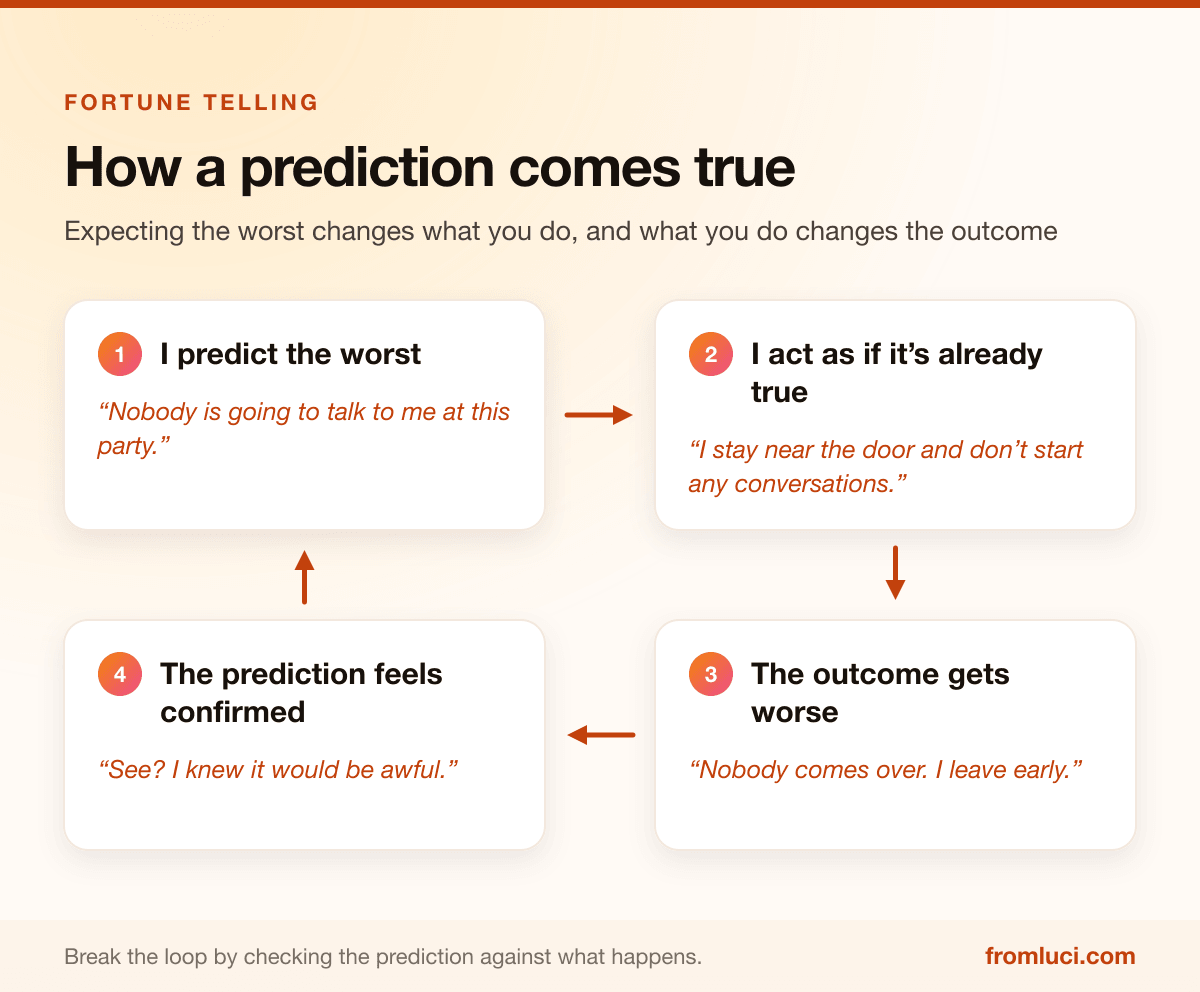
A self-fulfilling prophecy is a belief that changes how we act, and in doing so makes itself more likely to come true. The sociologist Robert K. Merton gave the idea its name in 1948.
Back to the party. Because the outcome is already pinned in our mind, we may hold back from conversations. We may also notice how different we are from the other guests far more than we would have if we had arrived with no expectations at all.
Or the school interview. We may downplay our achievements, sound unsure of our answers and show little energy for the communities the school has to offer. That first impression could be the very reason we are turned down. Not a lack of achievements or interest, but the low-energy state our own prediction put us in.
It keeps us from trying
Then there are the boots that hurt. We may end up keeping them just because we fear what will happen if we send them back. That's avoidance. In reality, if we had simply been honest, the store would probably have been happy to help. The boots were still in pristine condition, after all.
We suffer twice
Apart from avoidance and self-fulfilling prophecies, we also live through the outcome twice: once in our minds, and again if it actually happens. And even if it never happens, we have still suffered through the worst outcome at least once.
Suffering in advance doesn't soften the blow when the feared outcome does arrive, either. Believing it will is a mind trap of its own. Imagining that you might lose a loved one does not make losing them any less painful. Only time, and working through the grief, will slowly soften those rough edges.
Make no mistake: this doesn't mean we shouldn't prepare for things that might happen. It's no excuse to turn up unprepared or skip our due diligence. It only means we shouldn't make the worst outcome our default expectation, especially when there is little or no evidence for it.
Fortune telling or catastrophizing?
The two are close and often show up together. Fortune telling is predicting that one thing will go badly and treating it as settled. Catastrophizing takes it further: one bad outcome leads to the next, until a small worry has grown into a disaster. "I'll have no one to talk to at the party" is fortune telling. "I'll have no one to talk to, everyone will think I'm strange, and I'll end up losing my friends" is catastrophizing. The way out of both starts the same way: noticing the prediction and checking it against what actually happens.
How to stop fortune telling: keep a prediction log
Knowing that you fall into fortune telling is already a good first step towards breaking the habit. Try to reflect on your thoughts at least once a day. Think back to any moments when you caught yourself expecting the worst, and write them down: on a piece of paper, on a calendar or in any kind of digital journal. In Luci, for example, you can add "fortune telling" as a thought on a mood entry and use the journal to write about what happened.
The second step is where it gets useful: comparing the prediction with reality. Once the event has passed, write down what actually happened next to what you predicted. For example:
- Prediction: I'll hurt my knee at surf training. What happened: It went fine. I didn't hurt myself. I'm just not good at surfing... yet.
- Prediction: I'll miss the bus and have to walk all the way home. What happened: Funnily enough, I did miss the bus. But a colleague overheard me and offered me a lift, so it turned out great.
- Prediction: I'm losing my friend. She hasn't answered my texts for a whole week. What happened: She called today and explained she'd been up against a deadline at work. We're getting coffee next week.
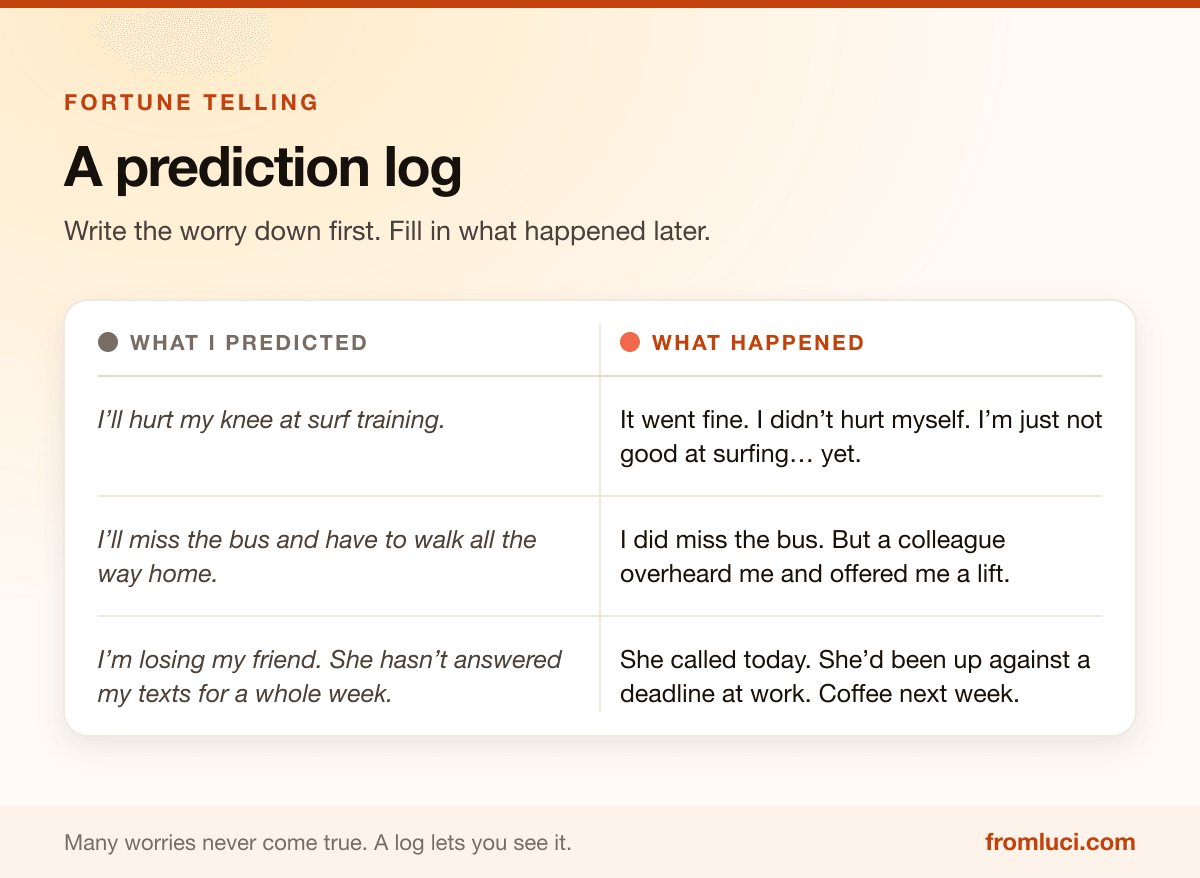
By reflecting not only on our thoughts as they come but also on how things turned out, we can train our mind to be less catastrophic in its predictions and make more balanced judgments.
There is research behind this. In a 2020 study, 29 people with generalized anxiety disorder wrote down their worries for ten days and tracked how each one turned out over the following month. 91.4% of the things they worried about never happened, and the most common result per person was that none of their worries came true. The people who saw the most evidence against their worries also improved the most. It's a small dose of CBT you can practice in real life.
Over a few weeks, a mood tracker can also show you when fortune telling tends to appear. Maybe it's before social plans, or on nights you slept badly. Luci's insights show how often a thought comes up and how your mood looks on those days.
Concluding
To recap: fortune telling is a mind trap where we predict the worst outcome without any evidence to support it. That can make the outcome more likely, because we start acting as if it were already true. And whatever actually happens, imagining the worst means living through it at least once.
To break the habit, start by spotting the pattern in everyday life. Write down the thought and the outcome you predict, and keep it somewhere close. Once the event has passed, write down what actually happened next to it. By paying attention to both the thought and the aftermath, we can unlearn a very natural tendency to fall into the fortune telling trap. Curious what other shortcuts your mind takes? Browse the full mind traps series.
If worrying about what might happen is making daily life hard, talk to your doctor or a therapist. You don't have to work through it alone.
Sources (5)

Luci
Find out what lifts your mood, and have more good days.