
What is an anxiety trigger?
An anxiety trigger is anything that tends to set off or worsen anxious feelings for you. It can be a situation, like a crowded room or a deadline, something physical, like too much caffeine or a short night, or a thought, like a worry that keeps coming back. Triggers differ from person to person, which is why tracking your own is more useful than reading a general list.
Example: You notice your chest tightening most afternoons. A few weeks of logging shows it happens mainly on days with three or more coffees and less than six hours of sleep, and hardly at all on days with one coffee, even when work is busy.
Anxiety rarely has a single cause. A short night, a third coffee, a tense meeting and a crowded train can each nudge it up a little, and on some days they all arrive at once. From the inside, that just feels like "a bad day". The pattern behind it only shows up when you write it down.
That is what tracking anxiety triggers is for. Not to diagnose anything, but to find out which things tend to come before your harder moments, and how they combine. This guide covers the triggers worth tracking, why it helps to keep them in the same place as your mood, how to set it up in any app or on paper, and how to read what you find.
If you want the bigger picture first, here is what a mood tracker can show you about anxiety.
Common anxiety triggers worth tracking
Everyone's triggers are different, but some come up again and again. Pick the ones that sound like you and leave the rest.
- Caffeine. Coffee, tea, cola and energy drinks. The NHS notes that caffeine can disrupt sleep and make anxiety harder to control. Track roughly how much, not every cup: none, a little, a lot.
- Sleep. How long you slept and how well. A short or broken night often leaves less in the tank for coping with whatever the day brings.
- Alcohol. It can feel calming in the evening and leave you more on edge the next day. Track it on the day you drink, and watch the day after.
- Meals. Skipped meals and long gaps between them are easy to miss and easy to track.
- People and social situations. Who you were with, and what kind of situation it was: a party, a one-to-one, a call with family.
- Places. Work, the commute, a busy shop, home. Some places carry more tension than we realize.
- Work and deadlines. Presentations, performance reviews, a full inbox on Monday.
- Your body. Tension, restlessness, tiredness or a headache. Sometimes the body notices before the mind does.
- Your thoughts. Worry, overwhelm, self-judgment. A thought that keeps returning can be a trigger in itself.
- Movement. Not a trigger as such, but worth tracking. The NHS lists regular exercise, like walking, running, swimming or yoga, among the things that can reduce anxiety and stress.
Why one place beats five
You could note your caffeine in one app, your sleep on your watch and your worries in a journal. The trouble is that triggers rarely act alone. A meeting might be fine after a good night and hard after a bad one. Two coffees might be fine on a calm day and too much on a busy one.
You only see those combinations if every trigger sits on the same entry as your mood. Then you can ask the questions that actually help. Is it the meeting, or the meeting after a short night? Is it coffee in general, or coffee after noon?
How to set it up
You can do this in any mood tracker that lets you tag your entries, or in a notebook.
- Choose five to eight triggers. Start with the ones you suspect most. Too many tags at the start turns logging into a chore, and a chore is the first thing to go.
- Log how you feel, plus what was going on. A mood or anxiety rating and a few tags. That is the whole entry.
- Log in the moment when you can. When anxiety rises, take ten seconds to note it and tag what is happening. Memory reshapes these moments quickly.
- Add one entry at a fixed time each day. The evening works well. Tag the day's sleep, caffeine and anything that stood out.
- Keep going for two weeks without changing anything. This is your baseline. Changing your habits on day one means you cannot tell what made the difference. There is more on this in the two-week method.
One caution. For some people, checking in many times a day turns into its own way of scanning for danger. If you notice that logging feeds the worry rather than easing it, log less often, or tag only what was going on for a while. The aim is a record you can look back on, not a habit of checking yourself every hour.
Setting it up in Luci
Luci is built for exactly this kind of tracking. Open Settings, then Tracking, and choose what Luci asks about when you check in:
- What you ate and drank has caffeine levels (none, low, high), alcohol, hydration and meals, including skipped meals.
- How your body felt covers tension, restlessness, energy, tiredness, pain and headaches.
- What was on your mind includes worry, overwhelm and self-judgment, and you can add thoughts of your own.
- Who you were with and What you got up to cover people, social situations and work. Add your own items, like "presentation" or "family dinner".
- Where you were is saved with the entry if you switch location on, together with the weather at the time.
- Sleep and steps come from Apple Health on iPhone, with your permission. The Android health connection is not currently available.
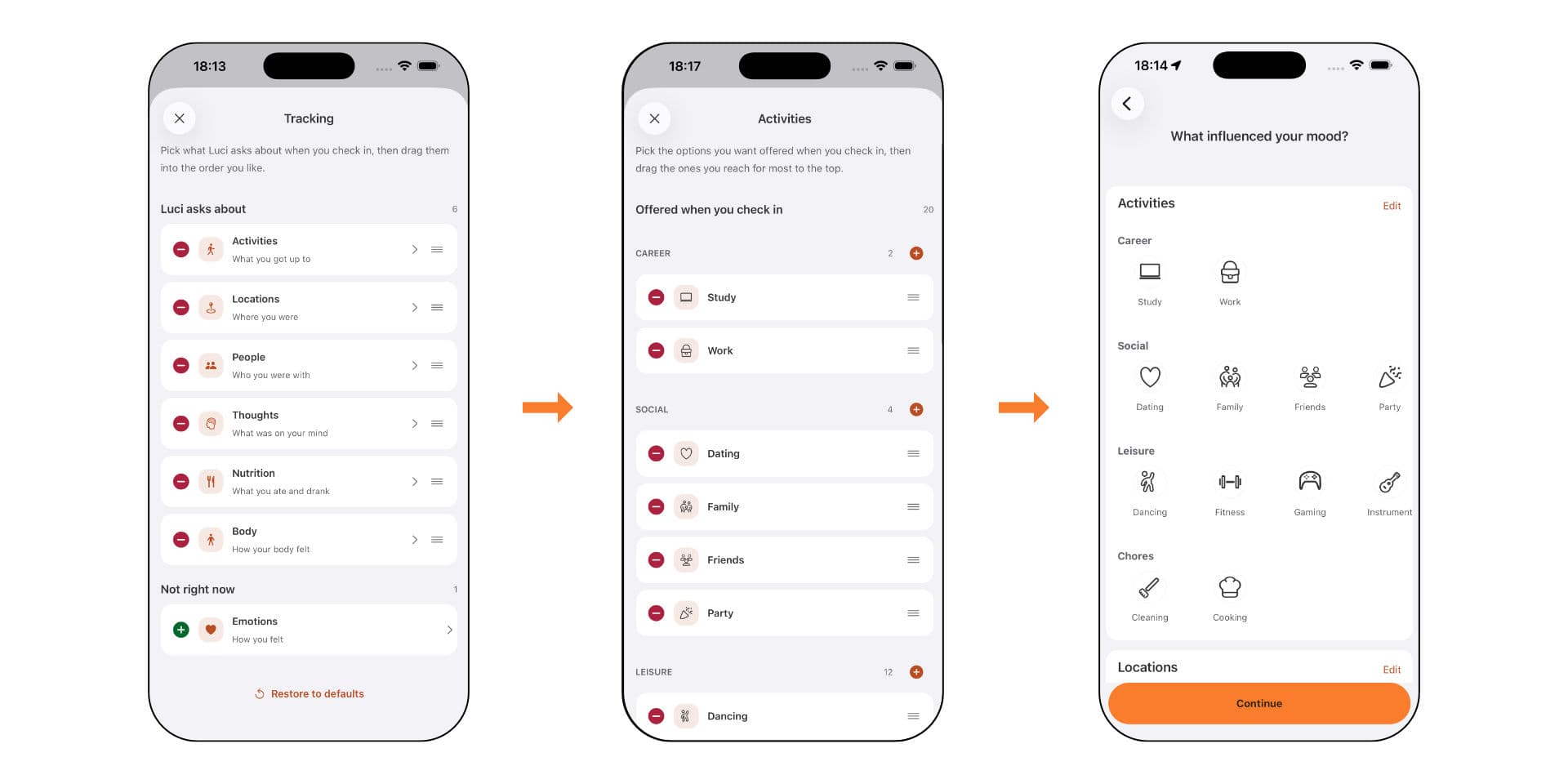
Put the triggers you care about at the top of each list, and hide the rest. Luci logs your mood rather than a separate anxiety score, so tag the emotion "Anxious" on entries where anxiety is part of the picture. Then you can see both how low the mood dipped and which triggers were present.
Reading what you find
After two weeks, look at what tends to sit next to your harder entries. In Luci, the mood impact list ranks everything you tagged by how your mood compares on those entries, and the time of day and day of week charts show when the harder moments cluster.
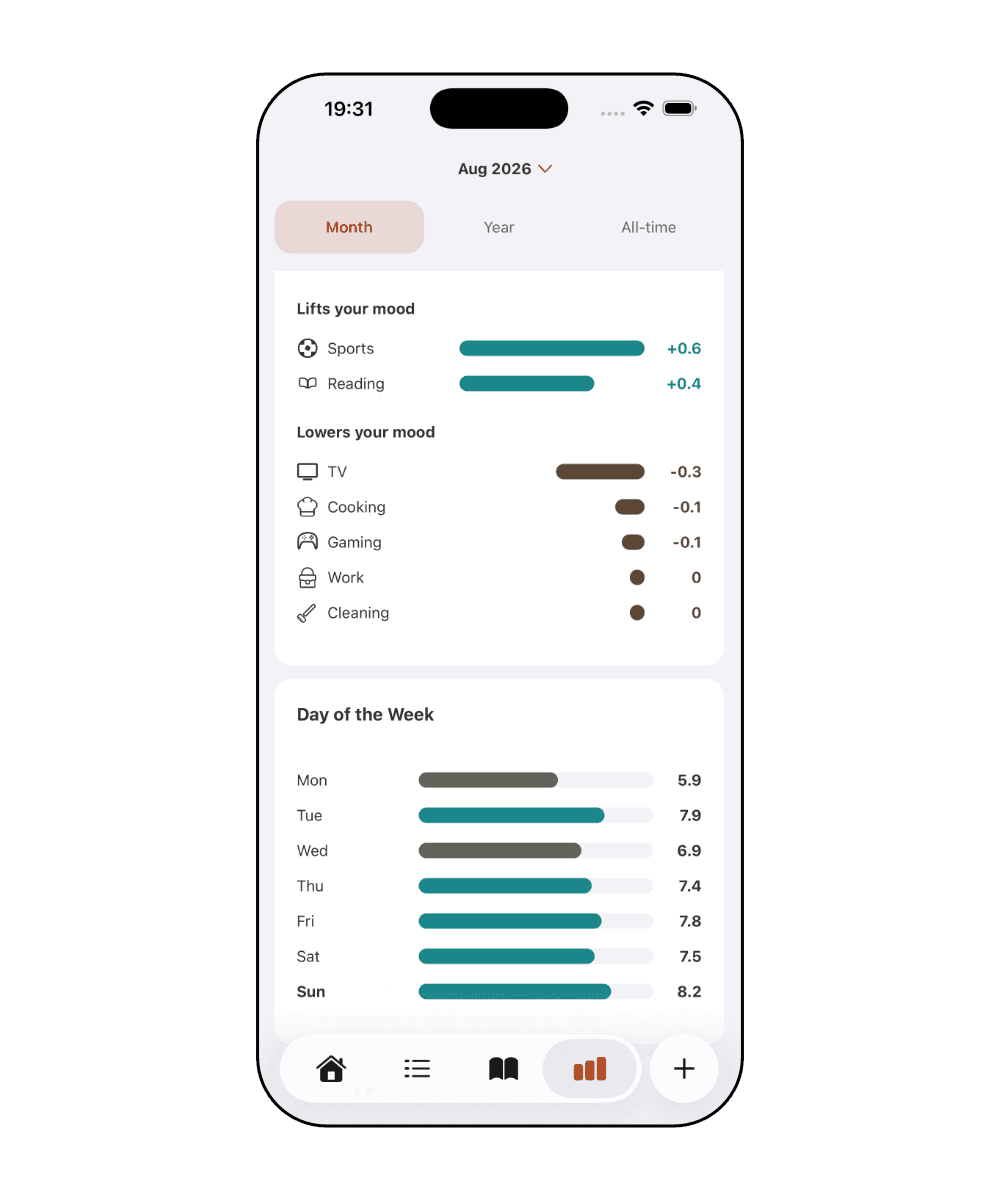
A few things to keep in mind as you read:
- Look for combinations. A trigger that seems harmless alone may matter when it meets another one. Compare days with both against days with only one.
- Associations, not causes. If anxious entries often carry "high caffeine", caffeine may play a part, or you may reach for coffee on days that were already stressful. The data shows what goes together. You work out the why.
- Test one change at a time. Pick the trigger that stands out and try a small change for two weeks, such as no coffee after noon. Keep logging the same way, then compare.
- Look at the good days too. What was present on your calmest days? Those are worth protecting.
Avoiding a trigger is not always the answer
Some triggers are worth cutting back, like the fourth coffee. Others, like social situations or speaking up at work, are part of a full life. Avoiding them can bring short-term relief while making the anxiety stronger over time, because you never get to learn that you can cope.
For those, tracking helps differently. It shows you when you are most likely to struggle, so you can prepare, and it shows you how often the feared outcome does not happen. That is the idea behind testing your predictions, one of the CBT techniques you can try on your own.
When to get help
Tracking triggers can make everyday anxiety easier to understand and manage. It is not a treatment, and it does not diagnose anything. Talk to your doctor if anxiety is affecting your daily life, if it has lasted for weeks, if you are having panic attacks, or if you are using alcohol or other things to cope. Effective treatments exist, including talking therapies such as CBT.
If you do see someone, your log can help. Here is how to share your mood tracker with a therapist or doctor.
Common questions
What are the most common anxiety triggers? Caffeine, poor sleep, alcohol, skipped meals, social situations, work pressure and recurring worries come up often. But triggers are personal, which is why tracking your own tells you more than any list.
Can caffeine cause anxiety? Caffeine can make anxiety worse for some people, partly by disrupting sleep. The NHS advises against drinking lots of coffee, tea, cola or energy drinks if you have anxiety. Tracking your intake next to your mood shows how much it matters for you.
How long should I track my anxiety triggers? Two weeks gives you a first baseline. A month or more shows patterns that only come around weekly or monthly, and makes it easier to tell a real pattern from a coincidence.
Should I track anxiety or mood? Both work. If your app has one rating, rate your mood and tag the emotion "anxious" when it is present. What matters most is logging what was going on at the time.
Can I track anxiety triggers on Apple Watch? Yes. With Luci you can log a mood and tag what was going on from your wrist, which makes it easier to catch the moment when it happens.
If you are struggling right now, please reach out to your doctor, a local helpline or emergency services. You do not have to manage it on your own.

Luci
Bringing light to your mental health journey.