
What is a mood diary?
A mood diary is a regular, dated record of how you feel, often with notes on sleep, activities and events. Therapists and doctors sometimes suggest keeping one between appointments, because a record written at the time is more reliable than trying to remember the past few weeks in the room. A mood tracker app is a mood diary that does the dates and the sums for you.
Example: Your GP asks how the last month has been. Instead of guessing, you open a one-page summary: twenty-two days logged, a dip in the second week after three short nights, and better days whenever you got outside.
"So, how have the last few weeks been?" It is one of the first questions in almost any appointment with a therapist, a GP or a psychiatrist. And it is surprisingly hard to answer. You remember yesterday clearly. You remember the one really bad day. The rest blurs into "okay, I think".
A mood tracker gives you a better answer. If you have been logging how you feel, you already hold a dated record of your weeks. This guide covers why that record helps, what to bring, how to prepare in about ten minutes, and how to use it in the room without letting it take over the conversation.
Why bring your mood log to an appointment
It turns out our memory is a poor record keeper for feelings. Researchers who study mood often ask people to log how they feel in the moment, a method called ecological momentary assessment, precisely because looking back is unreliable. Studies that compare in-the-moment logs with what people recall weeks later find that the two often disagree, especially about how much mood went up and down.
That is not a flaw in you. It's how memory works. Recent days and strong moments tend to crowd out the ordinary ones. A log does not have that problem. It's a better record of how you felt in the moment.
Bringing a log helps in three practical ways:
- It saves time. Appointments are short, so a summary lets you skip the reconstruction and get to what matters.
- It shows patterns you might not mention. You may not think to say that Sundays are always low, or that your mood drops after short nights. The log shows it clearly, even when you have not noticed it yourself.
- It makes hard things easier to say. Pointing at a week and saying "this one" can be easier than finding the words in the moment.
A mood log supports the conversation while keeping the human touch. It does not replace professional help, and it is not a diagnosis. Your therapist or doctor is the one who interprets what it means for you.
What to bring, and what to leave out
You do not need to hand over every entry you have ever made. A good summary is short enough to read in a couple of minutes.
A clear time period. The time since your last appointment is usually right. For a first appointment, the last one to three months gives useful context without burying anyone in detail.
Your mood over time. A simple chart or average per week shows the overall direction at a glance. Is it rising, falling or steady?
Patterns. Which days of the week or times of day tend to be harder. What you logged on your better days and on your harder ones. If you track sleep and steps, those are often worth including too.
A few dated notes. The days that stood out, in either direction. A sentence or two for each is plenty.
What you want to talk about. Write down two or three things before you go. The log is the evidence, and these are your questions.
What you can leave out. Your journal is yours and yours alone. You decide whether to share what you wrote word for word, or only the ratings and tags. Both are useful. If something is too private to share yet, leave it out. You can always bring it next time.
Ten minutes before the appointment
You do not need to study your own data. A short look the evening before can be useful, though, especially if it raises questions. Here's what to look out for.
- Pick the period. Since your last appointment, or the last month if it is your first.
- Skim the overall picture. Was it mostly better, worse or about the same as before?
- Mark one or two days that stood out. Note what happened on these days, if anything in particular.
- Look at what moved your mood. In Luci the mood impact list shows what you logged on your better and harder days. Pick anything that surprised you.
- Write your two or three questions. "I noticed my mood drops on days I skip lunch. Is that worth working on?" is a great question to walk in with.
- Decide how much text to share. All of it, some of it, or only the numbers.
If you are anxious about the appointment, don't worry, that's normal. You have already done the hard part by keeping the log and making an appointment. You do not have to present the log, just bring it with you and let it be a guide.
How to share it
Ask your therapist or doctor how they prefer to receive it. Some like a printed page they can make notes on. Some prefer a PDF ahead of time, so they can read it before you arrive. Some would rather look at it together on your phone.
A mood log is sensitive health information, so take a moment over how it travels. A clinic's patient portal or a printed copy handed over in person is safer than a forwarded email. If you are unsure, ask the practice what they use.
Paper trackers work too. A photo of a year in pixels page, or a month of your calendar, already says a lot.
Sharing a report from Luci
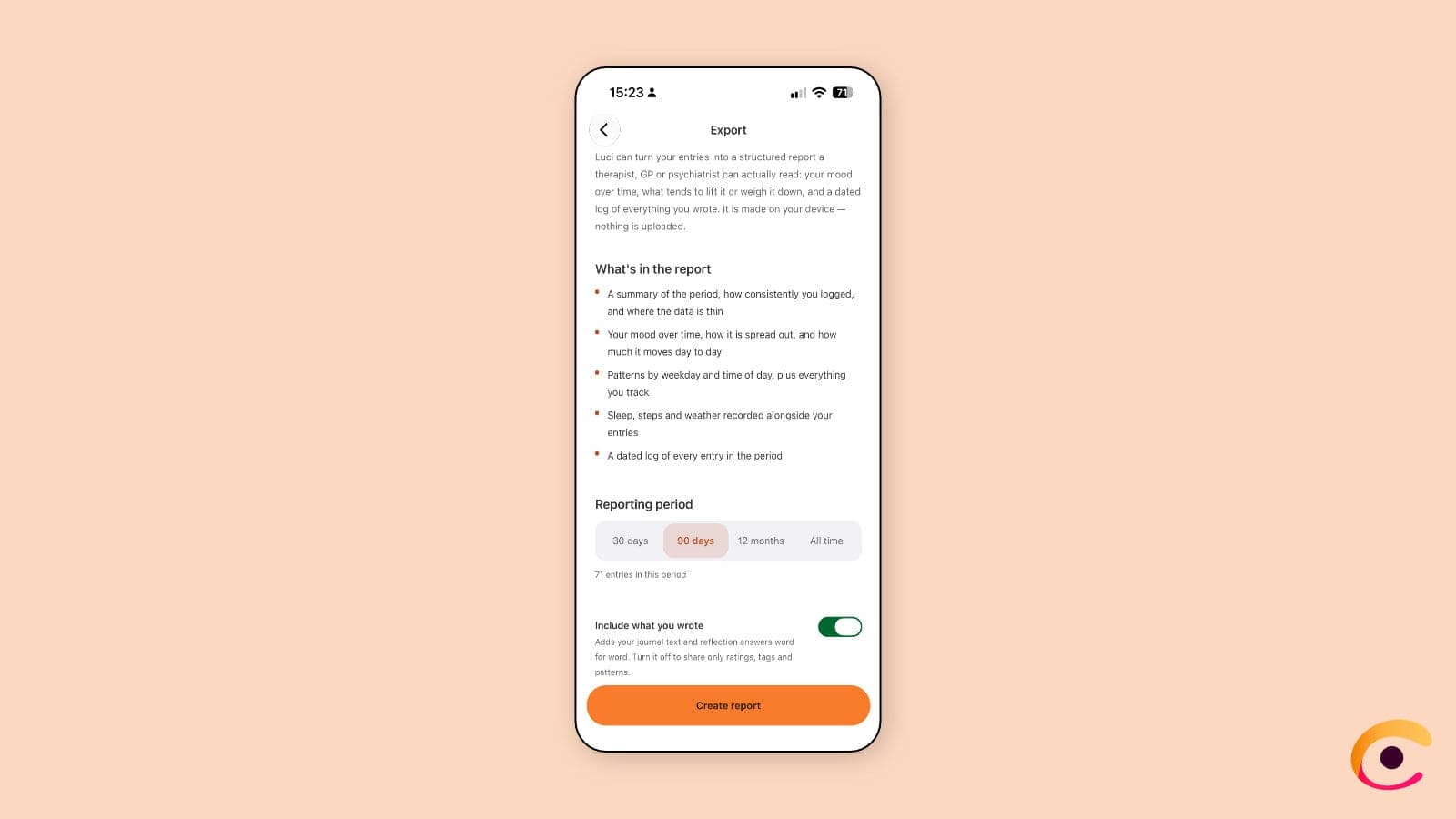
Luci can turn your entries into a report written for a healthcare professional. The report is free for everyone, with no Pro needed. It is made on your phone. Nothing is uploaded to create it.
- Open Luci's settings and go to Data.
- Tap Export for a healthcare professional.
- Choose the reporting period: 30 days, 90 days, 12 months or all time.
- Decide whether to include what you wrote. Turn it off to share only your ratings, tags and patterns.
- Tap Create report and share the PDF the way your therapist or doctor prefers.
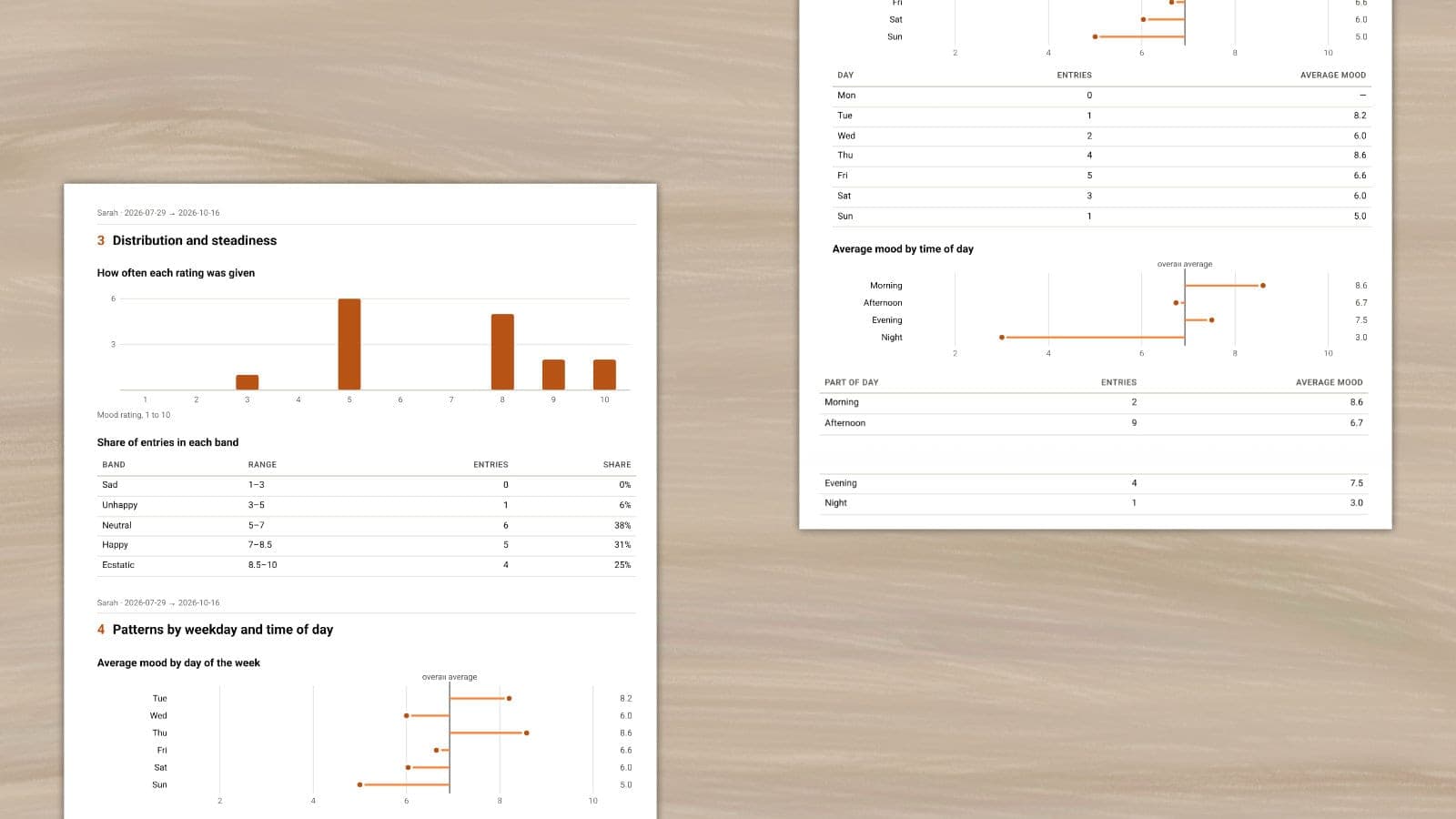
The report opens with a summary of the period, how consistently you logged and where the data is thin. After that come your mood over time, patterns by weekday and time of day, what you logged alongside your mood, sleep, steps and weather where you recorded them, and a dated log of every entry.
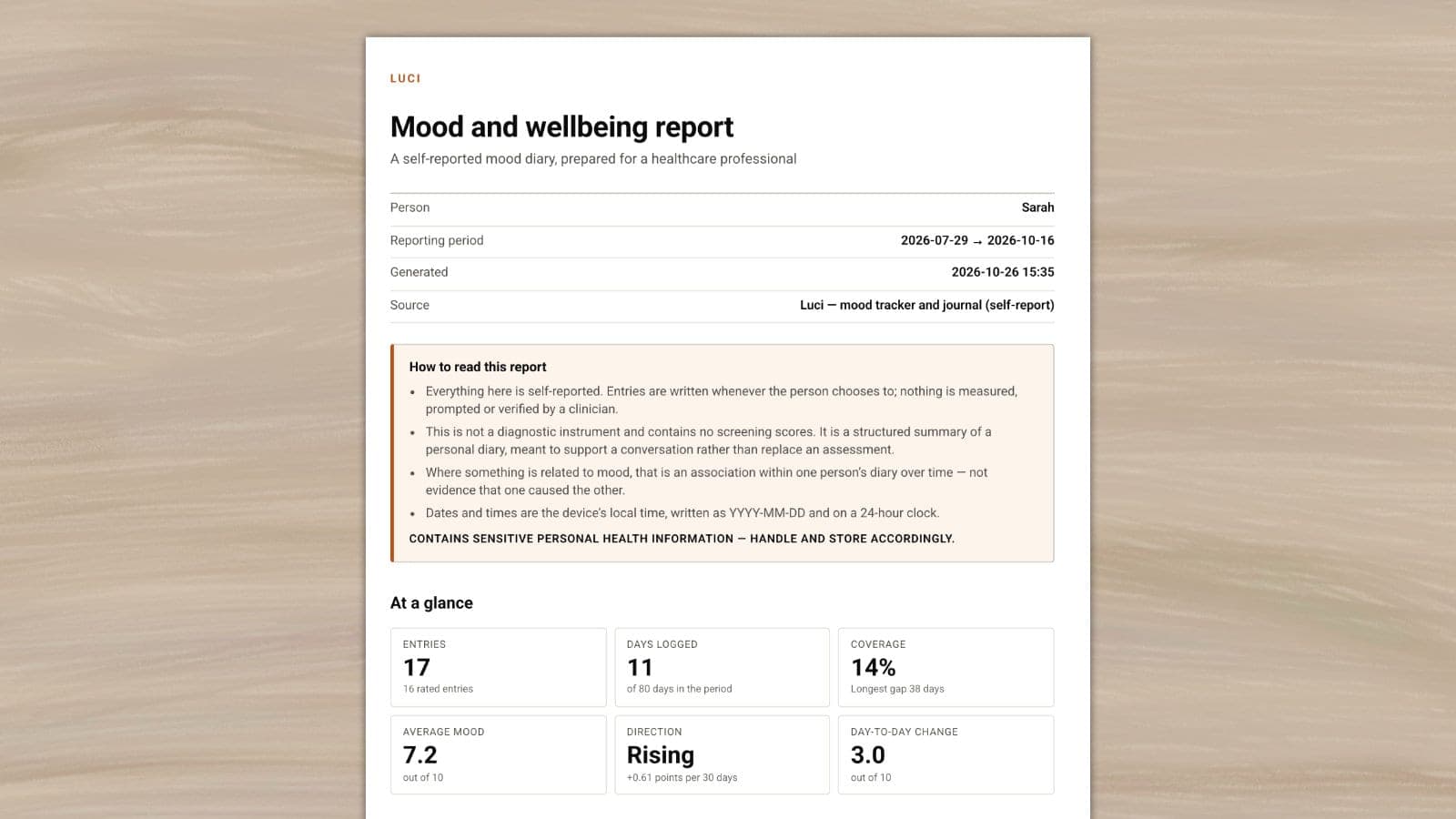
It is written to be read honestly. Every page makes clear that the entries are self-reported. Where something is linked to your mood, the report calls it an association, not a cause. And when there is not enough data for a figure to mean much, it says so instead of guessing. Your therapist or doctor can see at once what the numbers can and cannot tell them.
Note: If you ever want a copy of your data for yourself rather than a summary, the backup option is in the same Data section. Your history is always yours to keep.
In the room
Let the conversation lead and the log may follow. Your therapist or doctor may want to start somewhere else entirely, and that's fine. Bring the report out when it helps answer a question.
A few things that make it work well:
- Treat patterns as starting points. "My mood is lower on workdays" is a good thing to explore, not a conclusion. There may be a reason you have not thought of.
- Fill in the context. A low week during a family visit means something different from a low week out of nowhere. You know the story behind the numbers, so share it. That helps you both find the patterns that matter.
- Be honest about the gaps. If you stopped logging for two weeks, say so. A gap is information too.
- Ask what is worth tracking next. Your therapist or doctor might suggest logging something specific, such as sleep, a certain worry, or a new habit you agree to try. You can add these items to the Luci app after the session.
After the appointment
Keep logging, the same way as before. Little and often is plenty. If you agreed to try a change, the two-week method is a simple way to see whether it helps. Your next report will then show the period since this appointment, and you can both see what moved.
If an appointment brings up things you want to think through on your own, journal prompts can help you put them into words before the next one.
Common questions
Will my therapist want to see my mood tracker? Many welcome it, and some suggest keeping one. It is always fine to ask: "I've been tracking my mood. Would it help if I brought a summary?"
Should I share everything I wrote? Only what you are comfortable with. Ratings, tags and patterns are useful on their own. You can share the written entries later, or never.
How far back should the report go? Since your last appointment is usually right. For a first appointment, one to three months gives useful context.
Do I need an app for this? No. A paper diary or a calendar with a color per day works. An app saves you the counting and the charts, and keeps the dates straight.
Can a mood tracker tell me what is wrong? No. A mood tracker records how you feel and shows patterns in what you logged. Understanding what those patterns mean for your health is a conversation for you and a professional.
If you are going through a hard time right now and need support quickly, contact your doctor, a local helpline or emergency services. A mood log can wait. You come first.
Sources (2)

Luci
Bringing light to your mental health journey.