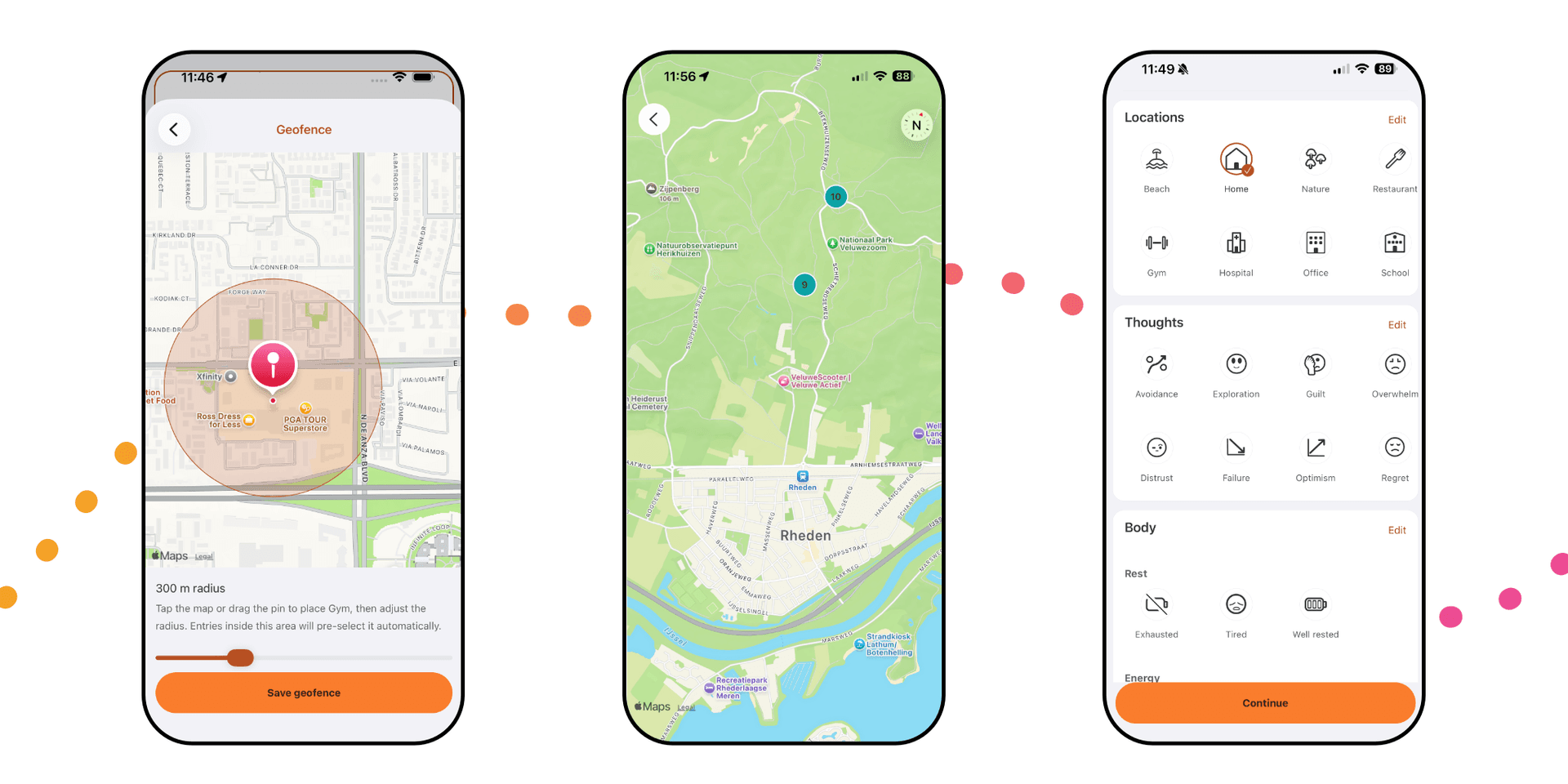
Some places really do bring out the best in us. We feel energised, happy and engaged the moment we arrive. Other places quietly drain us, running the battery down to near empty, and we often only notice once we've left. With a mood tracker, you have a wonderful opportunity to reflect on the places you visit most and what they mean for your mood. The outcome is usually different from the one you expect. Here's how to get started.
Manual or automatic?
The first question to answer is where your mood tracker lives right now. If you keep a journal on paper, we'd recommend adding labels, so that every day is tied to a place as well. Tag each entry with a word or two: "home", "school", "the city". After a few weeks you can see which days were shaped by where you went.
If your mood tracker is digital, check whether it supports location-based mood tracking. Support for this varies wildly from app to app.
The rest of this article assumes you are using an app, and describes the features available in Luci. If your app of choice is a different one, have a look at its documentation for the equivalent settings. Considering a switch? Luci lets you bring your journal with you from popular apps such as Daylio and Pixels.
Track your mood in the moment
The best way to start tracking locations is with one small habit: log your mood wherever you are, whenever you feel it, right there in the moment. It takes about ten seconds, and you can even do it from your Apple Watch. Luci automatically saves your location and attaches it to your mood score. Not every mood tracker does this, so make sure any location settings are switched on.
The magic of good data lives in the moment. The very moment you feel strongly about something, log it. Luci keeps it as raw as it comes, exactly the way you felt it. A week later you are reading the day itself, rather than your memory of the day.
Give your locations a name
All of this can happen in the background, but it does not have to. Prefer not to share your physical location (GPS)? No problem. You can simply tap a location and link it to your mood score instead. Say you're at school and feeling great: just tap "school" during your mood entry, and your score is saved to that location. Either way your journal stays on your device.
Luci comes with the most common locations out of the box, and you can hide the ones that do not match your lifestyle. You can re-order them too, so the place you need is the first one you see. As a Pro subscriber you can create as many custom locations as you could ever need, and give each one an icon so it is instantly recognisable.
Let Luci select the location for you
The best way to track location-based moods might be to marry the two. Think about it. You want to know where you were, and you never want to forget to attach a location to an entry.
With Luci you get both. Tap edit on the locations card, choose a location, and draw a circle around the matching area on the map. We call this geofencing. Whenever your device is inside that circle, Luci knows about it as soon as you open the app, and tags your entry for you.
In practice this means you can be at work, fill in your mood in ten seconds, and have it saved under "work" without opening the locations tab at all. From there, your locations feed everything else Luci does. Let's have a look at the patterns it may recognise for you.
Statistics and analysis
After a few mood entries across different places, Luci can do several things for you:
- Suggest a mood uplift in plain language: "you feel great in nature"
- Show the impact each location has had on your mood over a time period you choose
- Show a map with pins representing your average mood in each place: zoom in for more fine-grained, location-based moods
Once you start reflecting on your mood and location together, spotting patterns becomes another powerful tool for understanding yourself. We often don't realise how much a place shapes how we feel, and a mood journal tied to locations can help you discover which places lift you up, and where to spend more of your time.
Try it this week and start learning why some weeks feel heavier than others. You might be surprised how much of it comes down to the places you go, and the visits you decide to skip.

Luci
Bringing light to your mental health journey.